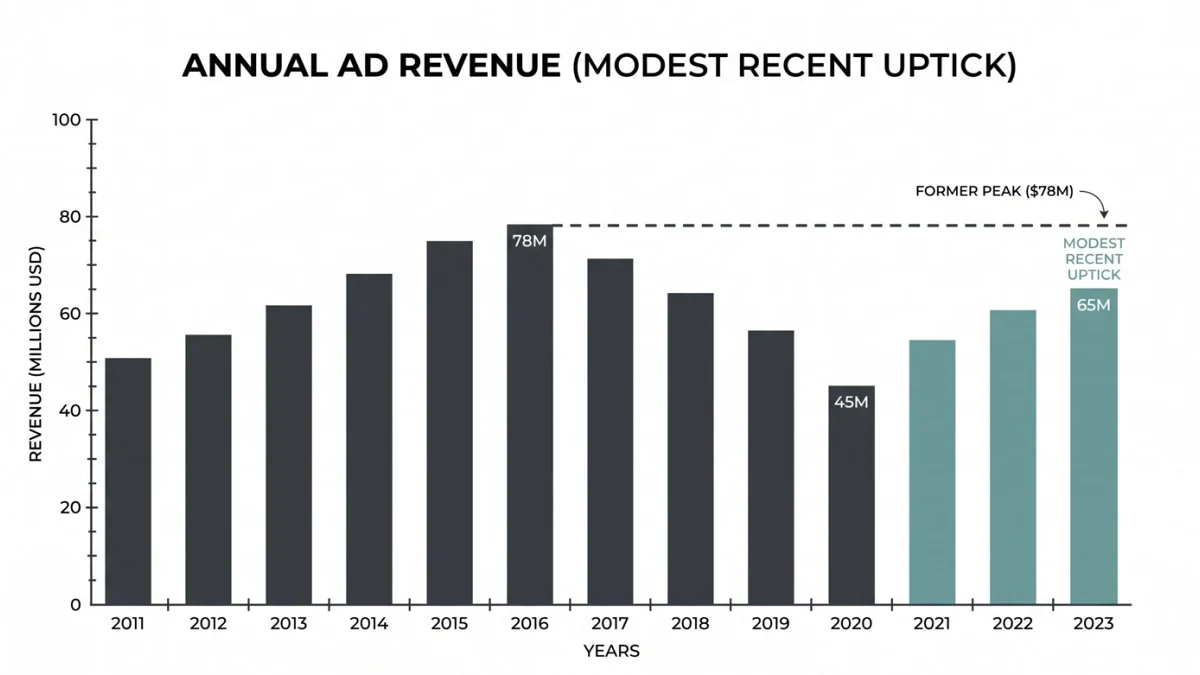
X's advertising business is recovering in the way its filings describe rather than the way its executives announce: revenue of roughly 1.8 billion dollars in 2025, up from about 1.7 billion the year before — growth, but less than half the scale implied by the top-100-advertiser comeback narrative, and still well below the roughly 2.3 billion peak of the Twitter era, per reported figures from the company's financial documents. The platform's own advertising leadership claims 97 of its top 100 advertisers have returned, with large U.S. clients growing more than 40 percent in 2025, as Digiday reported; forecaster eMarketer projected worldwide growth of about 16.5 percent for 2025, the first meaningful expansion since revenue fell by more than half after the 2022 takeover. A partial rebound, in short, priced accordingly.
The countervailing data explains the pricing. Kantar's marketer surveys recorded a net 26 percent of brands planning to reduce X spending in 2025 — the largest planned pullback of any major global ad platform — and quarterly figures through mid-2025 showed revenue wobbling, with one quarter down slightly year over year as advertisers continued to cite brand-safety concerns. The two pictures reconcile through the composition of returning spend: performance and direct-response formats, where measurable conversion arithmetic can justify cheap attention, have led the recovery, while the premium brand budgets that defined Twitter's advertising peak remain cautious — brand advertising requires reputational confidence that surveys show media buyers still withholding.
What does the recovery mean for news publishers?
Two things. Competitive pricing: X sells attention at a discount to its former self and to rivals, and any recovering inventory at those rates competes directly for performance budgets that might otherwise reach publisher sites. And a news-distribution question the platform has still not resolved: X remains a significant referral channel for journalism despite the traffic decline of the platform years, and its advertising recovery does not restore the publisher partnerships — the feed placements, the monetization programs — that existed before the takeover. Publishers' posture toward the platform has settled into wary opportunism: distribute through it, monetize elsewhere.
What should watchers track from here?
The brand-versus-performance mix in any disclosed figures — a recovery built on brand budgets would signal reputational rehabilitation, while a performance-led one signals only cheap attention. The platform's brand-safety tooling and third-party verification partnerships, the stated reason holdouts give. And the political-advertising line: the platform's relaxed rules around political content create inventory other major platforms restrict, whose growth would change both the revenue mix and the information environment around the 2026 midterms. The honest summary midway through 2026: advertisers returned to X the way buyers return to a discounted asset — selectively, cheaply, and without the loyalty that made the previous owner rich.