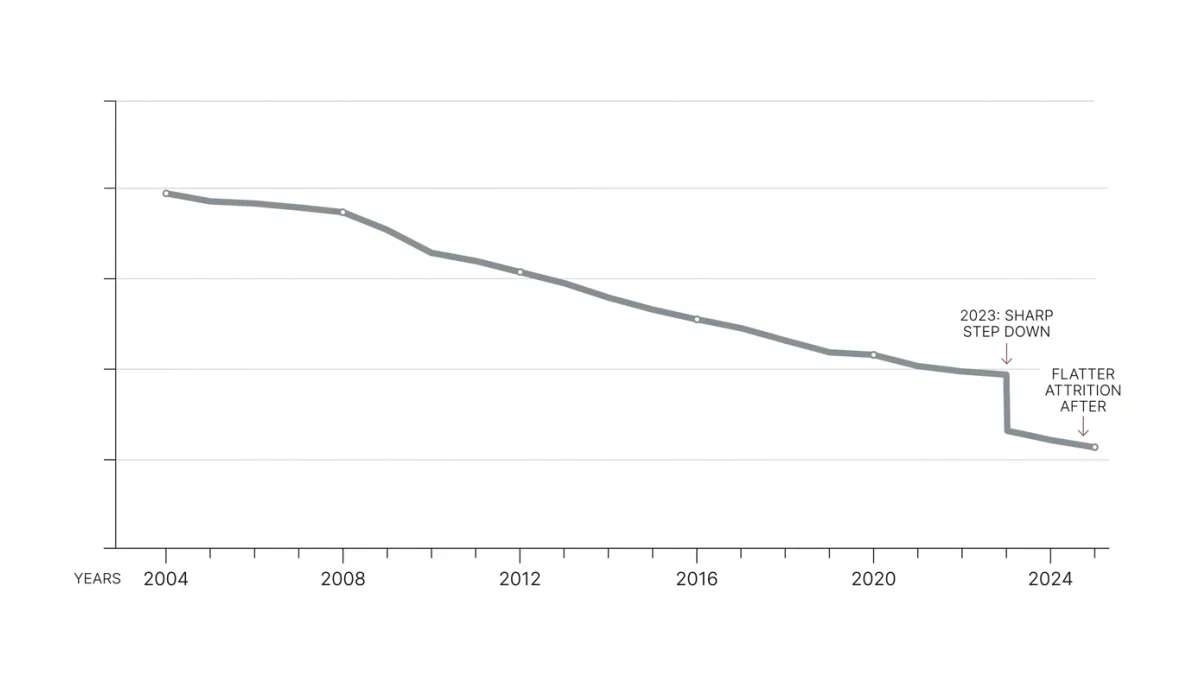
Newsroom job loss in the mid-2020s no longer arrives as dramatic collapse. The visible failure wave crested in 2023, when BuzzFeed News shut down outright, Vice Media entered bankruptcy, and Poynter's layoff tracker — the sector's standard count — recorded thousands of cuts in a single year. The subsequent pattern, documented through 2024 and 2025, is attrition inside survivors: the Washington Post's successive reductions including a major 2025 round, the Los Angeles Times' cuts of more than a hundred newsroom positions in early 2024, NPR's post-revenue-shortfall reductions, the Associated Press's buyout program for more than 120 U.S. journalists, and the continuing annual pruning at the chain-owned regional papers. Employment data confirms the shape: Bureau of Labor Statistics series for newspaper employment show a sector that has lost most of its workforce over two decades without a single year of stabilization.
Why did the character change?
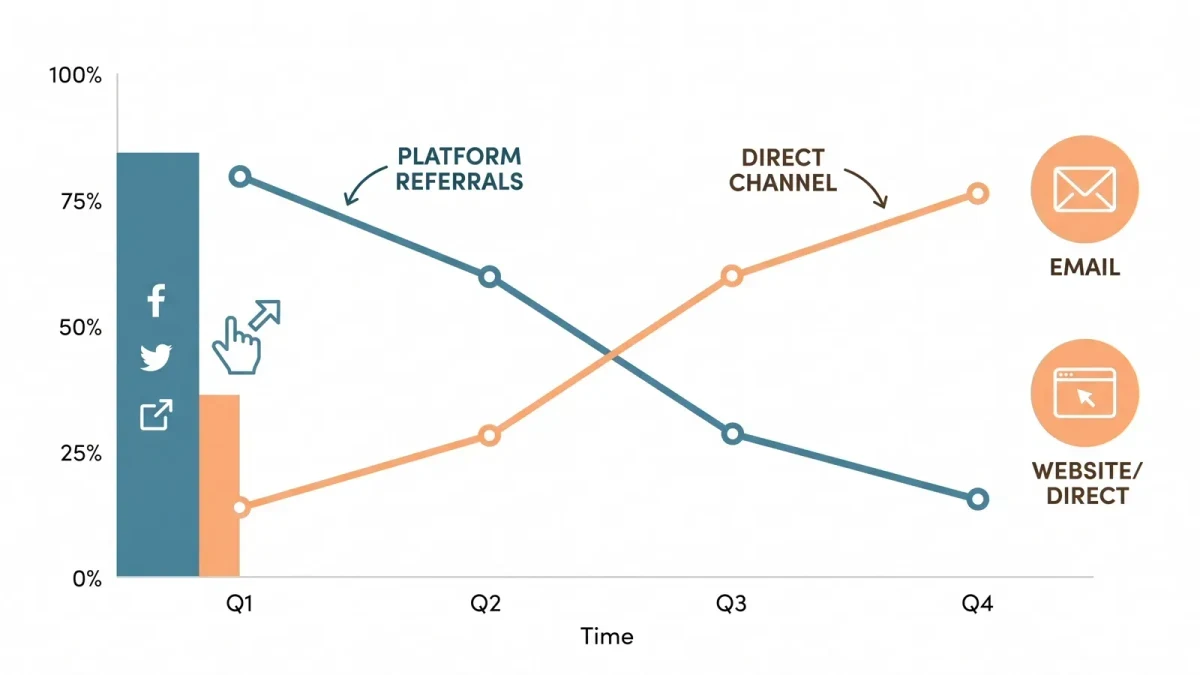
Because the business model experiments finished failing. The 2015-2022 digital model — venture-funded scale, social distribution, advertising monetization — ended when advertising rates and referral traffic collapsed together; its casualties were whole companies. What remains are institutions with real revenue — subscriptions, licensing, broadcast fees — whose cuts are surgical: a desk closed here, a layer of editing removed there, buyouts that select for the most senior (and most expensive) journalists. Attrition is less visible than collapse and cumulatively comparable, which is why the honest trackers now count vacancies never refilled alongside announced layoffs.
Which roles go first?
The documented pattern is consistent across the 2024-2025 rounds: editing and standards layers thin before bylines; photographers and visual journalists are cut early; statehouse and bureau positions consolidate; and mid-career reporters with beat expertise are replaced, if at all, by earlier-career general assignment staff. The functional consequences follow directly: fewer editors per published word, less verification capacity per claim, thinner coverage outside headquarters. Simultaneously, the industry's fastest-growing job families are audience, product and data roles — the newsroom of 2026 has more people working on distribution mechanics and fewer on the originating report.
What do buyouts hide that layoffs show?
Selection direction. A layoff removes positions management chooses; a buyout removes the people who accept — disproportionately the most experienced, whose salaries are highest and whose outside options are best. The AP's 2025 program and the Post's voluntary packages illustrate the trade: payroll falls faster than headcount, and institutional knowledge leaves faster than payroll. News organizations accept this knowingly, betting that senior expertise is substitutable; every editor who has run such a transition can describe where it was not.
Where are the jobs that remain?
Three sectors account for most journalism hiring in the contraction era. Nonprofit newsrooms, funded by philanthropy and memberships, are the growth segment — the Institute for Nonprofit News census shows steady expansion of member organizations. Business and specialty verticals — coverage of technology, finance, climate — retain pricing power with subscribers and advertisers. And newsletters-plus-platform independent journalism, the Substack-era sector, now employs a meaningful cohort of former staff journalists, though with business risk concentrated on each individual brand. The aggregate does not replace what left: the typical displaced local-news reporter does not become a newsletter operator; they leave the profession.
What should readers watch rather than announcement headlines?
Three indicators with more signal than layoff counts. Vacancy duration at outlets you rely on — how long a statehouse seat stays empty tells you the coverage's future better than any press release. The editor-to-writer ratio, visible in mastheads over time. And the age profile of hires, visible in the industry's own prize listings and byline surveys — an industry that stops hiring its mid-career layer in ten years stops having senior editors. The layoffs are the visible edge of a staffing structure being rebuilt smaller and younger; the structure, not the announcements, is the story.