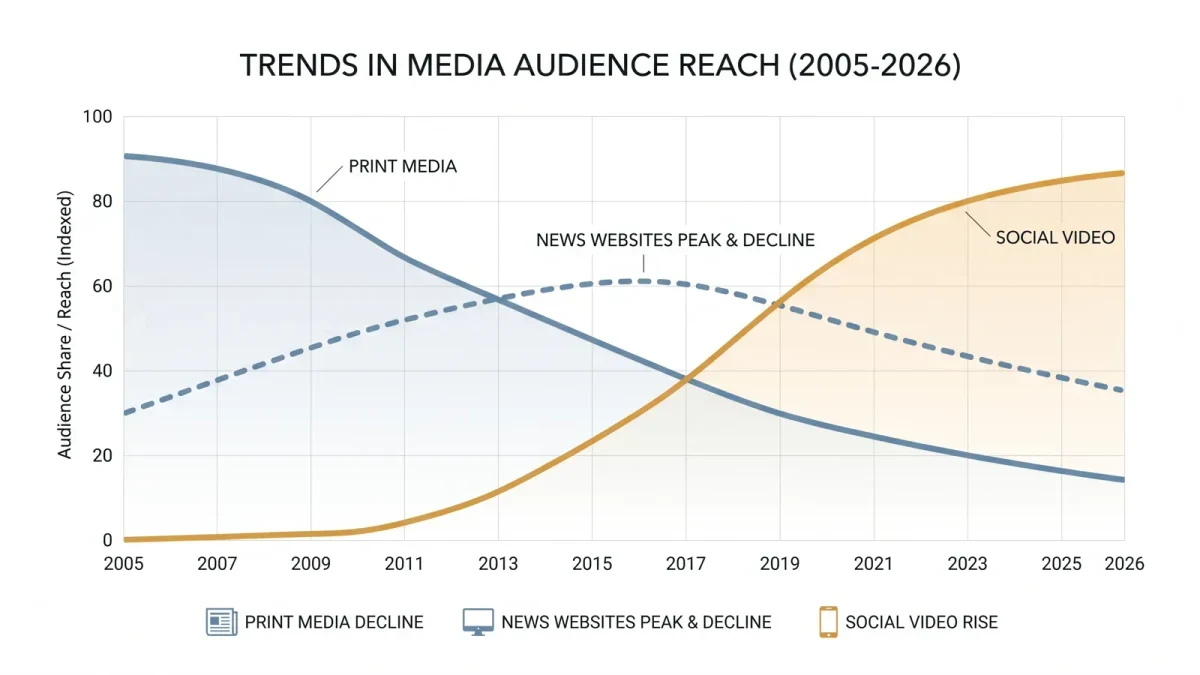
The transformation is now measurable at generational scale: the Pew Research Center's surveys, reported in September and December 2025, find that one in five American adults regularly gets news on TikTok — level with Instagram at about 20 percent and ahead of X at 12 percent — and that among adults under 30 the figure is 43 percent, up from 9 percent in 2020. Pew's companion research on young adults documents the same shift from the demand side: only 15 percent of young Americans say they follow the news all or most of the time, versus 62 percent of the oldest cohort — meaning the youngest adults are not watching less news so much as redefining where it is encountered: inside an entertainment feed, delivered by personalities, without a destination visit to any news organization at all.
The international pattern in the Reuters Institute's Digital News Report 2025 is broader still: social video news consumption rose across markets from 52 percent in 2020 to 65 percent in 2025, with TikTok news use highest in Thailand (49 percent), Malaysia (48 percent) and Kenya (40 percent), and Instagram and TikTok news use climbing while Facebook declines. The report's central structural finding is that influencers on TikTok, Instagram and YouTube are increasingly primary news sources for younger users — personalities explaining the news, often without any institutional journalism behind them.
What does the platform's news environment actually look like?
Three documented properties. It is explainer-first: the format rewards personalities who summarize and contextualize — a creator talking to camera about a court ruling outperforms footage of the ruling — so the platform's news diet is interpretation-heavy and reporting-light. It is audiovisual and vernacular: native formats, trending sounds, and casual delivery carry information that traditional packaging would flatten. And it is algorithmically individual: two users' feeds share no common front page, which eliminates the shared civic surface every previous news medium provided. None of these properties is hidden; Pew's own question — do you regularly get news there — measures encounter, not trust, and the platform's ranking of source trustworthiness by users sits below that of established news brands in the Reuters Institute data even as usage climbs.
Why the news industry's response has been ambivalent
Because the economics and the ownership politics both cut against participation. TikTok prohibits political advertising, so news organizations cannot monetize reach through the platform's ad system; distribution is an investment in brand with no direct return, which is why many outlets maintain a presence through individual journalists rather than institutional accounts. And the platform's Chinese ownership made it a policy football — the divest-or-ban statute, its litigation, and the 2025 resolution that kept the platform operating under a restructured ownership — leaving newsrooms wary of building on ground whose legal status was contested for years. The result documented in the Reuters Institute's country data: the space was filled by independent creators while institutions hesitated, and the explaining layer for young audiences is now largely outside journalism altogether.
What is at stake for the news ecosystem?
The verification layer. A generation encountering news through algorithmic explainer feeds develops sourcing habits formatted for that environment — personality trust, comment-section consensus, resonance as the credibility test — which transfer poorly to institutions whose authority rests on process. The honest reading of the Pew and Reuters data together is not that young audiences abandoned news; it is that the pipeline from raw events to young understanding has been rebuilt around a platform whose incentives reward engagement, and whose most trusted voices were selected by neither editors nor readers but by recommendation performance. News organizations that treat the platform as a distribution problem will keep arriving late to audiences that already have their explainers; the organizations treating it as a format problem — learning native vernacular while carrying over sourcing discipline — are the experiment to watch.