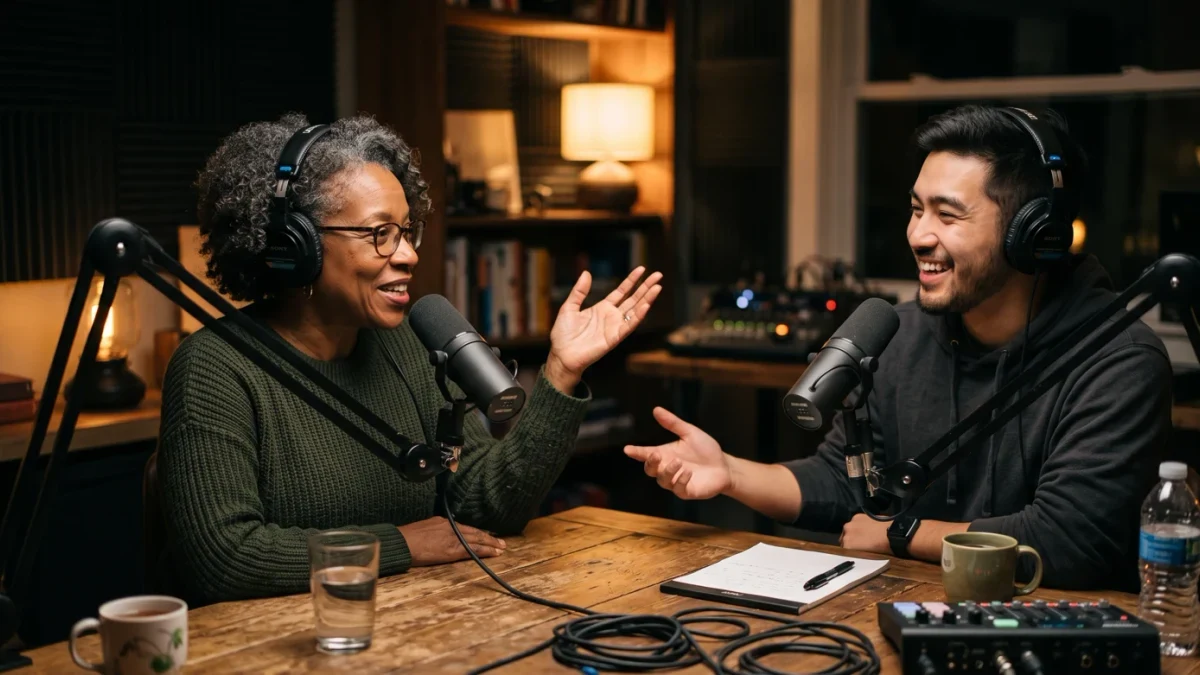
The long-form podcast interview has become a primary campaign channel rather than a supplement to it. The measurable audience base supports that status: Edison Research's Infinite Dial series has tracked weekly podcast listening rising from single digits of the U.S. population in the early 2010s to roughly a third of Americans aged 12 and older, and Pew Research Center's 2024 survey work found that about half of U.S. adults get news from podcasts at least sometimes, with under-30 audiences far likelier to prefer them to television. The 2024 presidential campaign demonstrated the strategic logic — the winning campaign's heavy investment in multi-hour interview appearances, including shows with audiences larger than cable news primetime slots, was followed across the spectrum by imitators in the 2025 off-year races and into the 2026 cycle. What has not followed is any accountability apparatus.
Why does the long-form format suit campaigns?
Three properties, each documented in practitioner accounts of the 2024 playbook. Control: the host is usually a friendly or at least non-adversarial interviewer, and no format rules cut off an evasive answer — the candidate sets pacing, tone and topics. Depth signals: a two-hour conversation reads as substance to audiences primed by short-clip politics, even when the content is uninterrupted talking points; the format manufactures the appearance of candor. And clip economics: every long interview yields dozens of short vertical video segments, each a paid and organic ad unit, so one appearance feeds a distribution system that a broadcast interview reaches only through excerpts chosen by an editor. The campaign buys reach and message discipline in a single transaction.
What accountability rules apply to podcast interviews?
Almost none, and the exceptions prove the gap. Broadcast equal-time obligations under the Communications Act apply to licensed stations' use of candidates' appearances — a rule built for the network era, which is why television bookers still lawyer candidate appearances while podcast producers do not. The Federal Election Commission's framework treats an interview as content unless the show charges candidates or coordinates paid messaging, and interviews-with-candidates on the host's editorial initiative sit outside contribution rules under the press exemption. There is no fairness doctrine to revive — it was repealed in 1987 and its reinstatement failed constitutional scrutiny when attempted — and platform-level political-content policies apply to paid placements, not to a host's conversational choices. The result: the most persuasive format in current campaigning is also the least regulated, not by oversight failure but because no existing instrument was designed for it.
What does podcast news consumption do to journalism's verification function?
It moves it offstage. A broadcast news interview is embedded in an institution with standards editors, correction practices and a schedule that pairs the candidate's claims with reporter follow-up; a podcast appearance is a standalone artifact consumed on trust in the host. Research on the format's news use — Pew's finding that podcast news consumers skew young and male, and Reuters Institute Digital News Report data showing high trust in personally selected sources relative to news brands generally — suggests audiences treat the parasocial relationship with a host as the verification mechanism. That substitution works tolerably when hosts are honest brokers and fails completely when they are not, with no correction architecture between the listener and the claim.
Are news organizations adapting effectively?
Mixedly. The successful adaptations borrow the format's strengths while retaining editorial function: interview shows produced by news organizations with real editorial challenge, and the clip-economics discipline the campaigns pioneered applied to accountability moments rather than talking points. The unsuccessful adaptation is the panel-discussion podcast — institutionally safe, dynamically inert — which competes for the same listening hours with a weaker product. The structural constraint is honest: an adversarial news interview cannot offer the control that makes the campaign podcast valuable, so the two formats will not converge; the editorial question is whether news-produced long-form can be engaging enough to claim the listening hours that friendly interviews now own.
What should listeners take from a campaign podcast appearance?
A rule of thumb that accountability journalists already apply: ask what the appearance cost the candidate. A broadcast interview risks a hostile question; a friendly podcast costs nothing but time, which is why campaigns happily supply unlimited hours of it. The clip you were sent was chosen by the campaign that made it, and the two hours of context it came from were curated by an interviewer whose business model rewards return guests. None of this makes the content false; it makes it marketing of unusually high production value — valuable precisely to the listener who knows that.