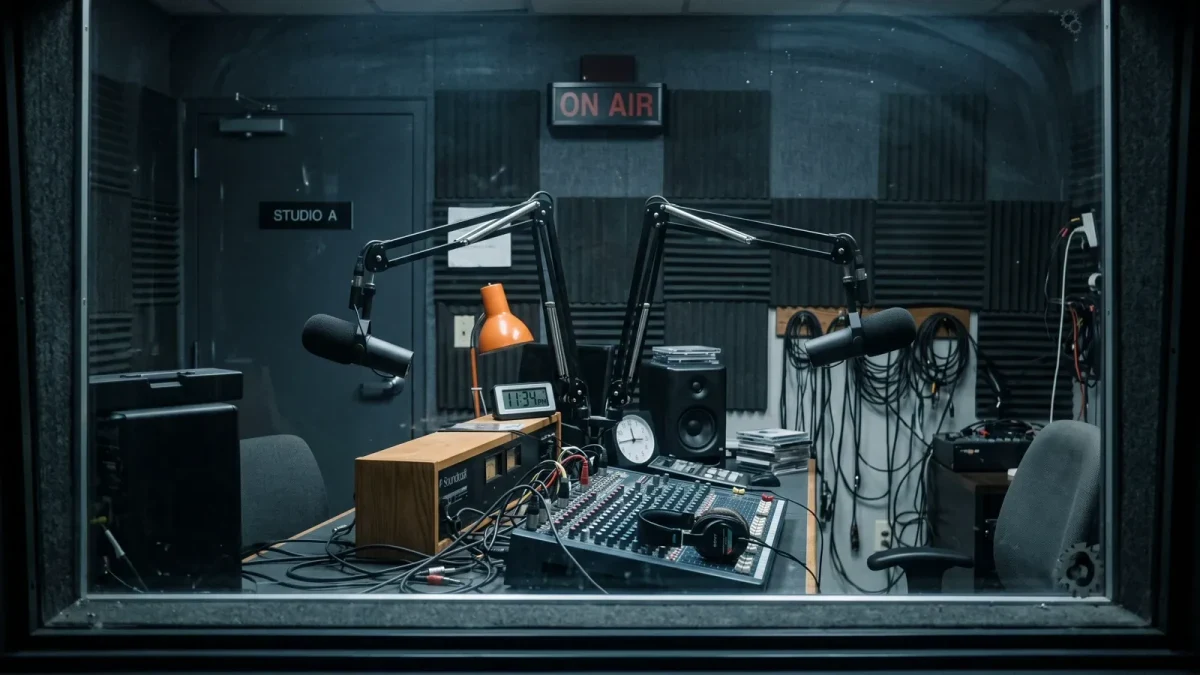
American public media's funding architecture is a deliberate historical compromise. The Corporation for Public Broadcasting — the private nonprofit created by the Public Broadcasting Act of 1967 — receives an advance federal appropriation, set two years ahead precisely so that no administration can punish the system in real time, and distributes it to local stations through Community Service Grants while supporting national programming. The federal share is a minority of the whole: CPB's own reporting puts the annual appropriation around 525 million dollars in recent years, while the public media system's total support — station-by-station, per the CPB-financed public broadcasting revenue reports — runs several times larger, dominated by viewer and listener contributions, corporate underwriting and, at larger organizations, foundation and university backing. The exposure is therefore distributional: many small rural stations depend on federal money for a large share of budgets, while the majors — the big-market PBS and NPR licensees with major-donor bases — could absorb the loss.
Why does the money flow through CPB at all?
To solve a censorship problem. The 1967 act's architecture — a corporation at arm's length from government, advance appropriations, statutory firewall provisions barring federal interference in content — was designed after the experiences that motivated it: earlier educational broadcasting had been captured or defunded by state-level political pressure. The two-year advance, which looks bureaucratic, is the system's core constitutional insulation: a Congress angry at coverage cannot reach next year's money, only the year after. The firewall provisions — reinforced by the 1979 amendments and later statutory language — prohibit CPB from producing or supervising content, which is why NPR and PBS produce programming and CPB funds infrastructure, stations and interconnection rather than editorial operations.
What did the recent political fights actually target?
The appropriation, and the executive's leverage over it. The documented sequence of 2025: rescission proposals and executive actions attempting to defund CPB, litigation over whether appropriated-but-unobligated funds could be clawed back, parallel pressure on NPR and PBS through leadership attacks, and the periodic resurrection of privatization proposals that have recurred since the 1990s without enactment. The legal question the episodes tested — the bindingness of multi-year appropriations against executive recission — is bigger than public broadcasting, and the litigation it produced was still working through the courts into 2026. The political fact is structural: a content-adjacent federal expenditure whose beneficiaries include journalists is permanently available as a target, and the advance-appropriation insulation delays but does not prevent congressional action.
How do stations and networks actually raise the rest?
With the public radio membership model, one of the most successful audience-funding operations in media. On-air pledge drives, membership programs and donor pipelines supply the largest single revenue share at most NPR member stations; corporate underwriting — advertising's regulation-bounded cousin, restricted in content by FCC and statutory rules — supplies most of the rest of non-federal support at major stations. PBS's model is similar with a stronger foundation and corporate-sponsorship skew, plus the programming-distribution economics of its national suite. The system's funding diversity is genuinely high by media-industry standards, which is why total-system apocalypse forecasts overstate the case; the vulnerability concentrates in the stations serving small markets where no pledge base exists to replace a federal grant.
What does the money buy editorially?
Local newsroom capacity, mostly. The Community Service Grants fund station operations including local journalism; NPR's own newsroom is funded substantially through member-station program fees and sponsorship rather than direct CPB grants, and PBS programming support flows through separate production-funding channels. This is the firewall's practical effect: federal money is upstream and general, editorial money is downstream and plural. The critique from both directions persists — that the insulation is fictional because stations self-censor to protect funding, and that the money is unnecessary because the majors could survive without it — and both critiques have documented anecdote behind them while the system's structural design continues to do the specific thing it was built to do: keep the funding decision and the editorial decision in different hands.
What should observers watch?
The appropriation's forward years — the numbers legislated for future cycles are the system's runway; the Community Service Grant formula, whose rural weighting is where small-station viability lives; and the litigation over appropriation recission, whose outcome will set precedent for every multi-year federal commitment. Public media's political weather is cyclical, but the funding architecture has survived every previous storm because it was engineered for exactly this one; the current test is whether the engineering holds when the storm arrives from the executive branch rather than Congress.