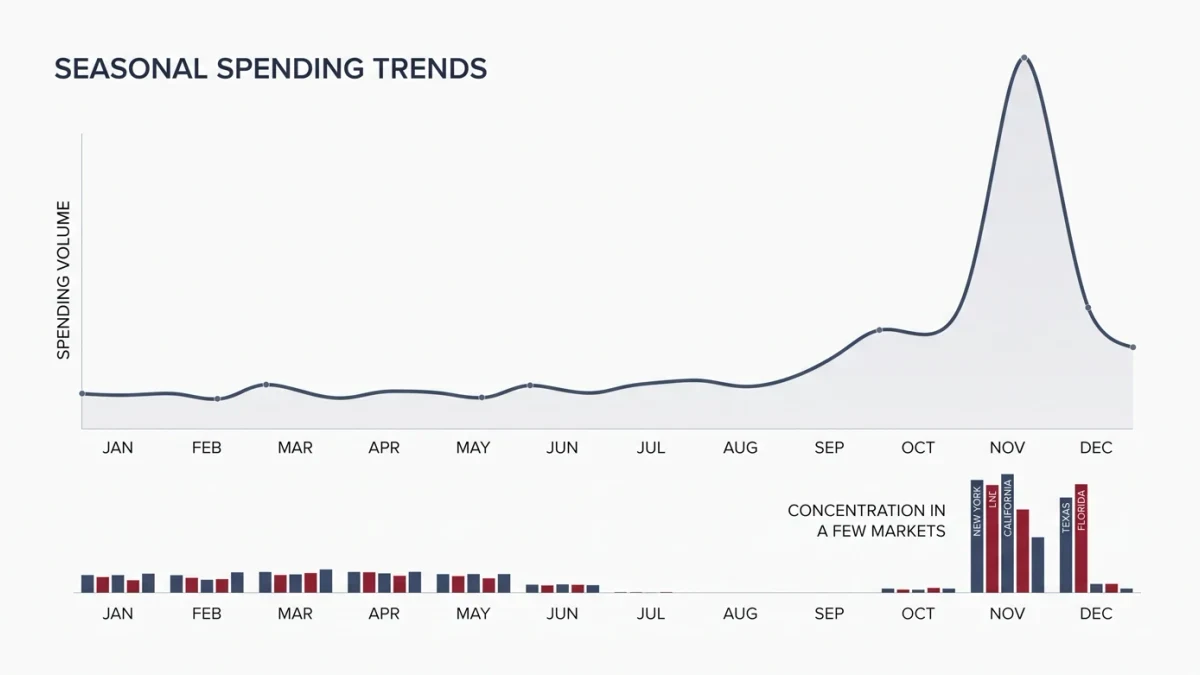
U.S. election advertising is one of the economy's largest scheduled media purchases: tracking firms — AdImpact and its predecessor operations are the standard commercial counters — projected the 2023-2024 cycle's political advertising at more than ten billion dollars across federal and state races, with the presidential contest alone in the billions. The money is enormous but radically uneven: Federal Election Commission data and the media-tracking record show concentration in a handful of battleground states, a handful of late months, and a shrinking set of channels — broadcast television still dominant, connected TV rising fast, digital targeting increasingly unmeasurable at the buyer level. Understanding the flow explains the economics of every election-season media market.
Why does broadcast television still dominate?
Habit, reach and law. Older voters — the highest-turnout cohorts — remain heaviest in linear television, and a media buyer's job is votes per dollar, not innovation per dollar. Broadcast also offers the 48-hour lowest-unit-rate rule: federal law requires stations to sell candidates their lowest rates in the 45 days before a primary and 60 before a general election, which makes late broadcast inventory legally cheap for candidates (though not for super PACs, which pay commercial rates — a subsidy structure that shapes who buys what). The consequence, documented in station disclosures, is that election advertising is a major profit line for broadcasters in swing markets: political is effectively a fourth quarter, and the FCC's political files — public, searchable — show the rates and volumes deal by deal.
Where is the money migrating?
Two destinations. Connected TV is the growth channel: ad-supported streaming tiers and addressable inventory let campaigns deliver different spots to different households in the same program — the microtargeting apparatus married to television's format — and buyers' reports through 2024-2025 show CTV as political's fastest-growing line. And unmeasured digital: the platform channels — Meta, Google pre-restriction, and the streaming-social borderlands — carry persuasion at unit costs invisible to the trackers, with disclosure dependent on the platforms' ad libraries rather than third-party measurement. The measurement asymmetry is itself an economic fact: a dollar of broadcast spending is publicly auditable in the political file, a dollar of streaming-targeted spending substantially is not.
What does the money do to media markets?
It distorts them seasonally and geographically. In Columbus, Phoenix or Philadelphia in October, political demand crowds commercial advertisers out of inventory, raising rates for everyone — local businesses in battleground markets effectively subsidize the election — while markets in California or New York see almost none of it outside Senate races. For local news operations in swing states, the quadrennial windfall is material revenue; for the same operations' non-election years, its absence is part of the revenue volatility that ownership consolidates to absorb. The pricing seasonality also shapes strategy: campaigns pre-commit rates early, and the arbitrage between early commitments and late spot markets is a standing line in media buyers' postmortems.
Does the spending work?
The research consensus is precise and deflationary. Persuasion effects of general-election advertising are small and decay quickly — the political science literature, including Gerber and colleagues' large field experiments, consistently finds marginal effects near zero in saturated presidential races, because both sides are already advertising at saturation. Where advertising demonstrably moves outcomes is in the gaps: down-ballot races where one side outspends the other heavily, special elections with low information, and primary contests where name recognition is the binding constraint. The economics therefore rationally concentrate presidential spending anyway — turnout mobilization, base enthusiasm and ground-game signaling — while the persuasion justification mostly decorates the invoices.
What should readers watch in the next cycle?
The CTV share disclosure — the line where political money's migration to streaming becomes publicly countable; the political files of three or four swing-state stations, which will show the rate and volume war earlier than any poll; and the super-PAC-versus-candidate split, because the lowest-unit-rate subsidy applies to one and not the other, making candidate committees' relative share a measure of how much of the spending is rate-advantaged. The billions are not a single phenomenon: they are a subsidy-hunting, market-concentrated, measurably inefficient purchase that nonetheless no campaign can afford to skip — the definition of an arms race.
Where does the money not go — and why does that matter?
Most congressional districts, all non-battleground states, and nearly every newsroom. The concentration means the persuasion arms race is experienced by perhaps ten million persuadable voters in six or seven states, while two hundred million others see almost none of it — a fact that recalibrates every claim about advertising's effect on the electorate. For local media, the geography is regressive: the stations owned by large groups with battleground clusters collect the windfall, while the outlets serving the information-poor markets that most need revenue receive nothing. And for the campaigns' own incentives, the concentration teaches the parties to weight policy attention toward the same handful of states the advertising targets, which is the electoral-college structure reproducing itself in the advertising market.