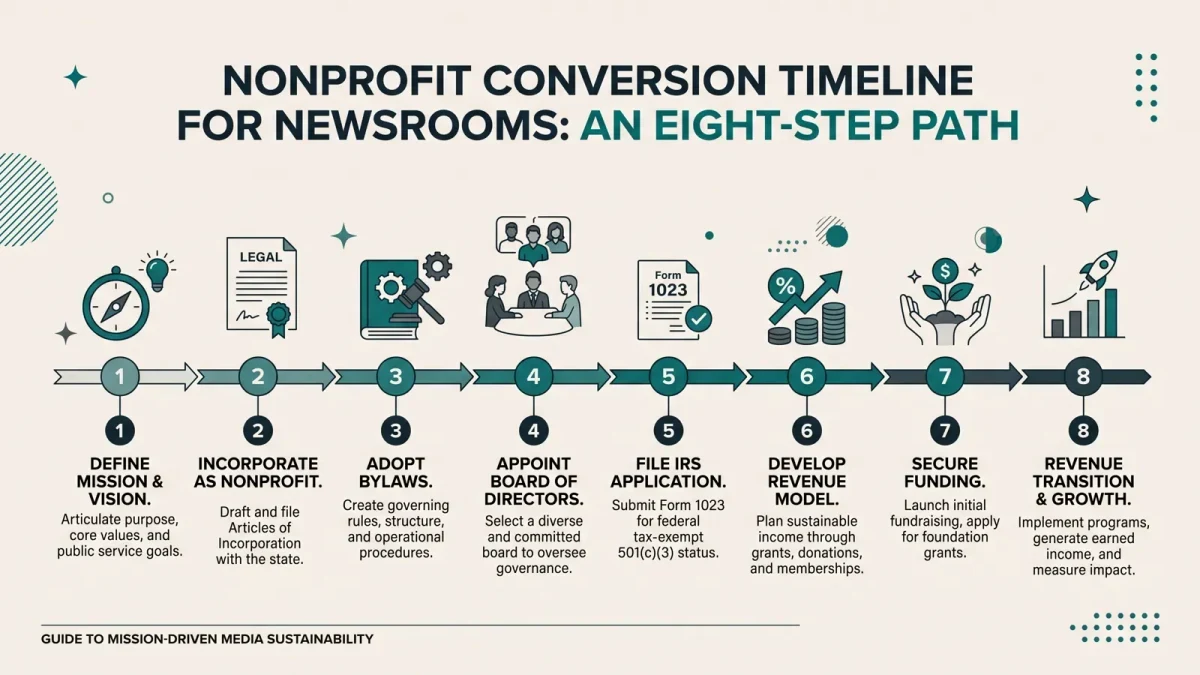
Nonprofit journalism is now a large sector of the news industry rather than its margin. The standard industry census — the Institute for Nonprofit News's annual reports — counted more than four hundred member newsrooms in the mid-2020s, with combined revenue in the hundreds of millions of dollars, concentrated in state and local accountability reporting. The model's growth logic is straightforward: the advertising base that funded twentieth-century journalism left, and the cause — informed communities — is fundable by foundations, individuals and government programs in ways that entertainment is not. The results include some of the strongest accountability reporting of the decade. The stress points are equally structural, and 2025's political environment — federal pressure on public media funding and state-level scrutiny of news subsidies — tested them in real time.
Where does the money come from?
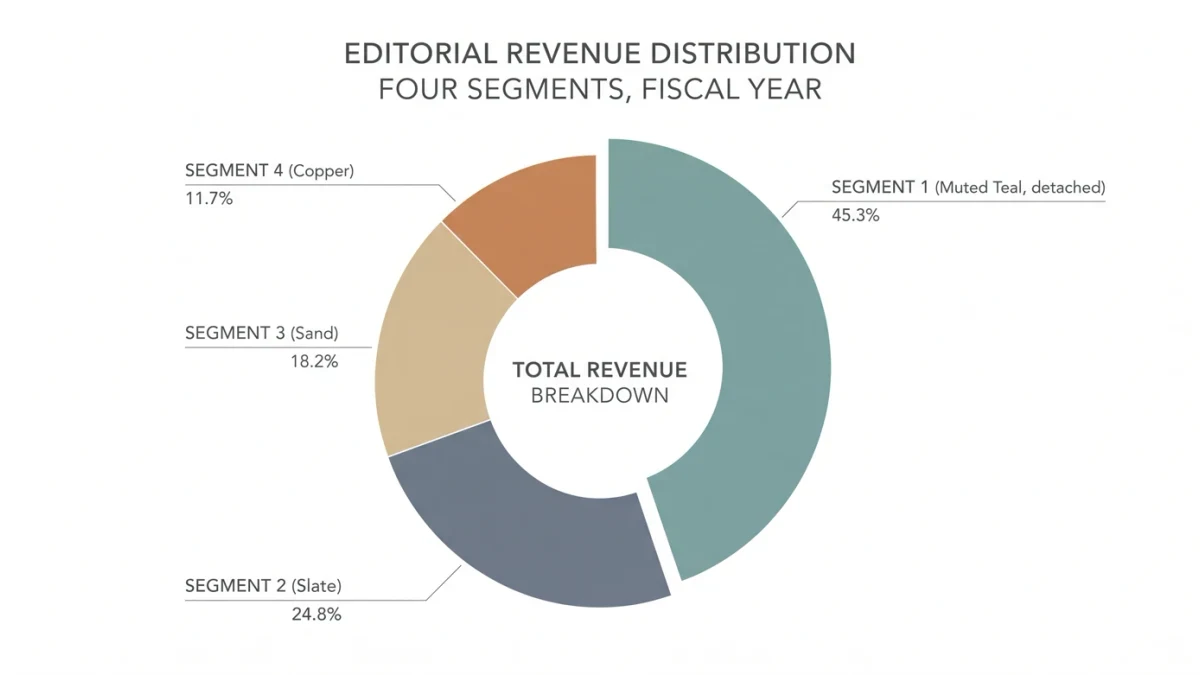
Four streams with different properties. Large foundations — journalism funders including Knight, MacArthur and a set of regional community foundations — supply grants that build organizations but rarely fund operations indefinitely; their stated strategy is catalytic, not sustaining. Individual donors, cultivated through membership programs, are the revenue line with the best long-run economics: recurring, unrestricted and aligned with readership growth — the Texas Tribune's long-disclosed model runs substantially on a mix of members, events and foundations. Government support — state tax credits, public notices, and CPB-adjacent programs — arrived in several states during the closure wave and became politically contested immediately. And earned revenue — events, sponsorships, licensing — behaves commercially and concentrates among larger organizations. The mature nonprofit newsroom resembles a public radio station's funding stack more than a newspaper's.
What are the structural weak points?
Three. Concentration: a meaningful share of sector funding flows from a small set of national foundations whose program priorities change on leadership cycles — when a funder's strategy shifts from local news to, say, AI or climate, an entire cohort of grantees faces simultaneous cliffs. Grant-cycle mismatch: most grants run one to three years while accountability reporting's payoff is reputational and slow; newsrooms staff beat coverage with money that expires before the beat matures. And independence optics: foundation-funded journalism invites the attack that it is advocacy by another route — an attack leveled at outlets across the political spectrum, and answered structurally only by disclosure and funder-independence policies like the sector's standard editorial-independence codes.
Does foundation funding bias coverage?
The honest evidence is mixed and mostly reassuring on content, less so on topic selection. Studies comparing foundation-funded and commercial accountability reporting have not documented systematic ideological slant; funders' contracts typically carry independence clauses. What funding demonstrably shapes is what gets covered: issue areas aligned with funder priorities — climate, education, health equity — attract money, so beats follow grants. That is the same editorial-market selection that advertising produced in a different direction (coverage of industries that advertised), and a reader evaluating a nonprofit outlet should read its funder list the way an earlier reader read a newspaper's biggest advertisers.
What did the 2025-2026 political environment change?
It converted a quiet weakness into a live risk. Federal proposals and executive actions targeting public-media funding — the CPB appropriations fights and litigation over attempts to condition public broadcasting support — raised the sector's political exposure, and several states saw bills to bar public funds for news organizations. For nonprofit newsrooms the consequence is planning discipline: diversified revenue is no longer best practice but survival architecture, and the sector's consultants now advise that no single funder — including government — should exceed the share whose sudden loss would close a beat. The Texas Tribune's multi-stream model, long an outlier in its disclosure-heavy rigor, became the template because it was built for exactly this weather.
Can philanthropy scale to the closure problem?
Not alone, by the arithmetic. Total U.S. journalism philanthropy runs in the low hundreds of millions of dollars annually against an advertising decline measured in billions; even the optimistic projections of journalism-funding collaboratives close a fraction of the gap. What the nonprofit sector has demonstrated instead is a different production function: smaller teams, collaborative networks that share investigation costs across outlets, and university partnerships — the Medills and the university-run statehouse bureaus — that substitute institutional overhead for commercial revenue. The realistic future for most communities is a hybrid: a nonprofit accountability outlet, a commercial or public broadcast partner, and state subsidy, none sufficient alone.