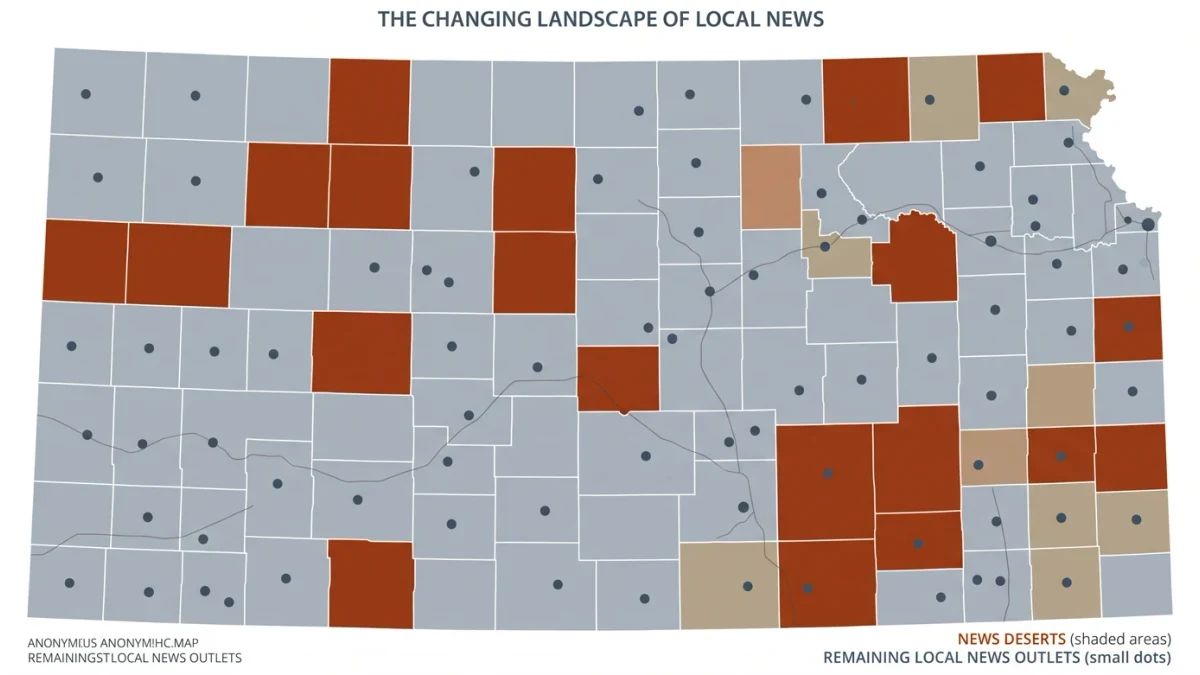
Local newspaper closure is a fixed-cost arithmetic problem. The American count maintained by Northwestern's Medill State of Local News report — the field's standard tracker — found that by its 2024 and 2025 editions the country had lost roughly a third of its newspapers since 2005, with closures and mergers continuing at a pace of roughly two and a half per week in recent counts, leaving more than two hundred counties without any local news outlet and most others with a single fragile survivor. The economics underneath are consistent across case studies: a newspaper's costs — a newsroom, a press or press contract, distribution, back office — are substantially fixed, while its revenue base, once dominated by local advertising tied to retail, autos and classifieds, has been unbundled line by line. When revenue crosses below the fixed floor, the enterprise closes rather than shrinks, because the product cannot be made cheaper without ceasing to be the product.
Where did the revenue actually go?
Not primarily to readers' abandonment. Paid circulation declined but remained substantial; what left was advertising, in a specific order. Classifieds — historically the highest-margin line, famously 30-40 percent of many papers' revenue — migrated to vertical platforms (jobs to Indeed and LinkedIn, autos to AutoTrader, real estate to portals) within roughly a decade. Display followed audiences online, where programmatic pricing and platform intermediaries take most of the dollar before it reaches a publisher's ad server. Retail consolidation — the shift from local department stores and dealerships to national chains buying nationally — removed the local advertiser category entirely. Each loss left fixed costs untouched, which is why papers that looked profitable in the 1990s could not find a smaller stable size in the 2010s.
Why don't closures produce entrants?
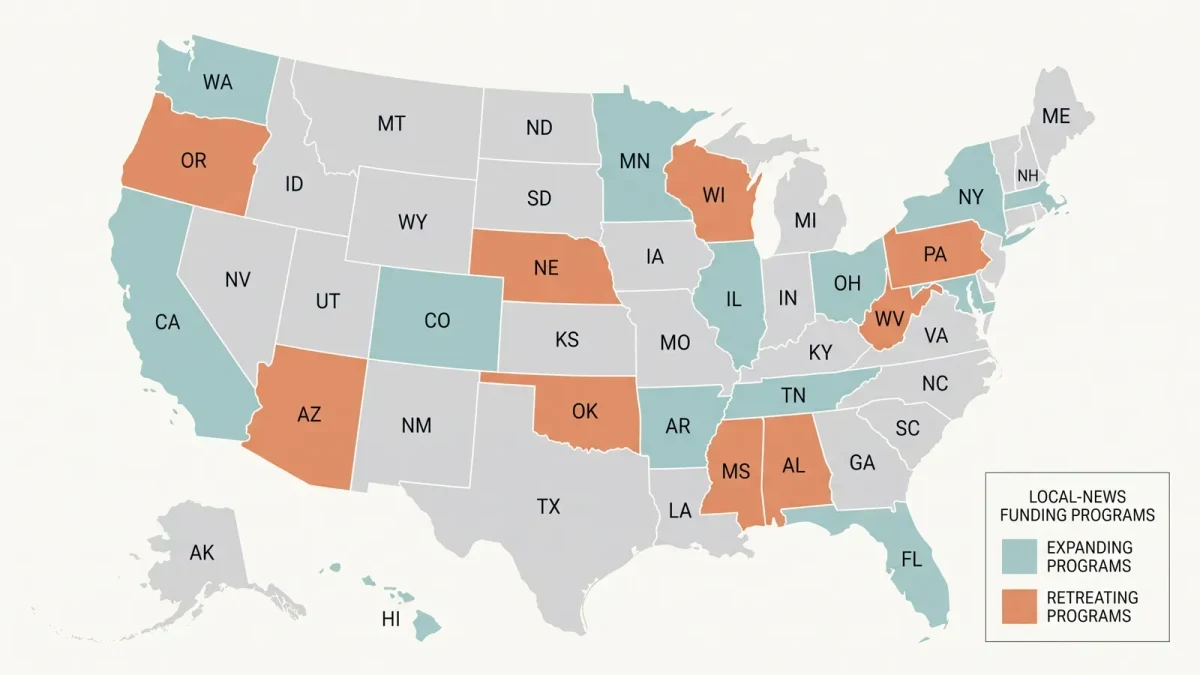
Some do — Medill's own census counts several hundred digital-only local startups — but the entry rate runs far below the closure rate, and the entrants are smaller. The entry barrier is not capital; it is the advertising base that no longer exists at the local level to support any newsroom. A digital startup inherits the same unbundled revenue environment that killed the incumbent, minus its brand, archive and print franchise. Where entrants succeed, the documented models are nonprofit and philanthropic, subscription-dense small markets, or state-supported mechanisms like New Jersey's Civic Info Consortium and the expanding set of state payroll-tax credits for hiring local journalists — public money substituting for the advertising base that left.
What happens to the asset after closure?
Consolidators buy the remains. Hedge-fund and private-equity ownership — Alden Global Capital most prominently, with Gannett's rollups on the public side — acquired distressed dailies, cut newsrooms toward the fixed-cost floor, and monetized the residual: circulation revenue from aging print loyalists, printing contracts, real estate, and operational consolidation into regional clusters. The financial logic is documented in Alden's own investor materials reported by press investigations: returns came substantially from cost extraction rather than revenue growth, which explains why ownership concentration accelerated as closures made assets cheap. The chain, not the market, is the closure wave's survivor.
What are the documented civic consequences?
The best-identified effects come from matched studies of places that lost papers. Research following the 2017 closures of the New York Daily News's suburban bureaus and nationwide panel studies associate newspaper loss with increased municipal borrowing costs — lenders pricing weaker information environments — lower competitive rates and higher salaries for city officials, and reduced split-ticket voting as residents fall back on national partisan frames without local coverage. Each finding is contested at the margin, but the direction is consistent and the mechanism named by the researchers is monitoring: nobody attends the four-hour zoning meeting unless someone is paid to.
Can the decline be stopped — or only slowed?
The honest evidence supports slowing through subsidy and philanthropy, not reversal through market repair. The measures with observable traction are journalist-hiring tax credits adopted in several states, public notices legislated back into local outlets by state law, and nonprofit conversions of dailies. The market mechanisms proposed — antitrust cartels for collective negotiation, platform payments — delivered sums an order of magnitude below the lost base. The closure curve is the trailing edge of an advertising model that ended, and the policy question is no longer how to restore it but how much of the monitoring function a democracy will decide to fund directly.