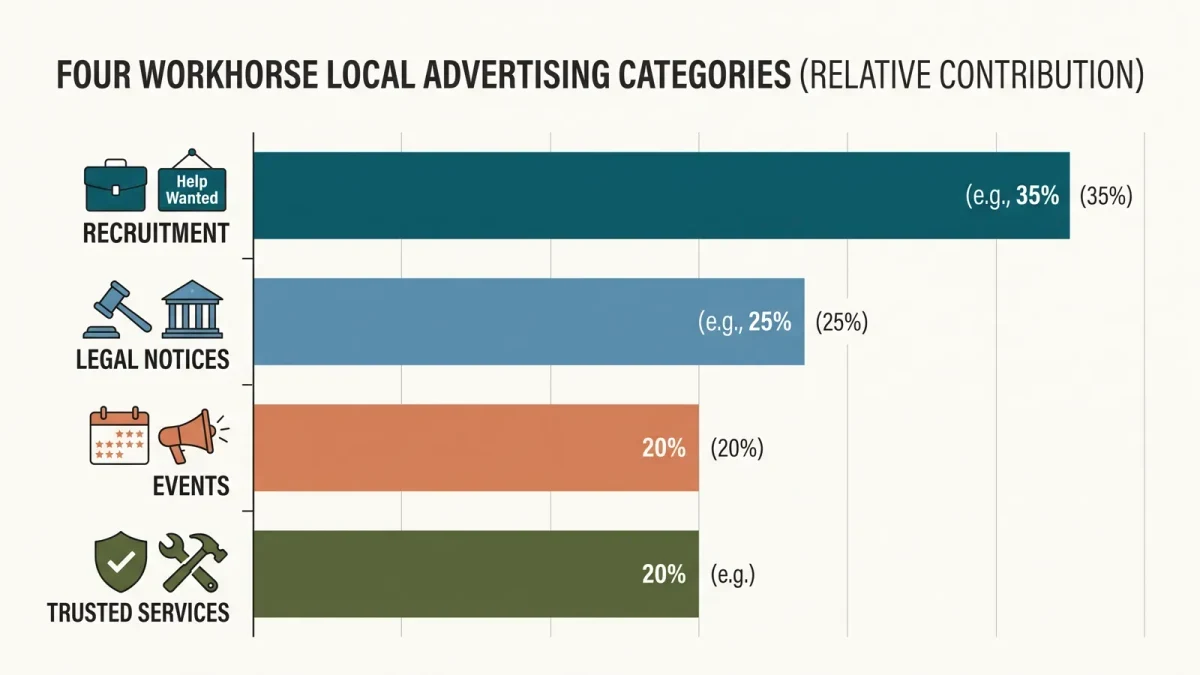
Classified advertising — the small text listings for jobs, cars, apartments and personals — was, by margin, the best product the newspaper business ever had. At its late-1990s peak, classifieds commonly contributed 30 to 40 percent of daily newspaper revenue, per the Newspaper Association of America's historical series: no production cost beyond typesetting, no sales expense beyond a counter clerk and phone bank, priced by the line, and sold to sellers whose alternative was a yard sign. The section functioned as the local economy's search engine — buyers and sellers meeting where everyone already looked — and its economics subsidized the newsroom the way nothing has since. The collapse, when it came, was total and fast: U.S. newspaper classified revenue fell from the tens of billions annually (over 17 billion dollars in 2000, at the peak of the recorded series) to under two billion within two decades, as the categories unbundled into purpose-built platforms.
How did the unbundling proceed?
Category by category, each to a platform whose product was better at that one thing. Employment went first and hardest — job boards, then Indeed and LinkedIn, offering search, résumé databases and application tracking that print could not. Autos followed the listings sites and then the marketplaces. Real estate shifted to portals and agents' own web presences. Personals went to dating apps, a category the internet rebuilt rather than migrated. By 2010 the process was effectively complete; Craigslist alone, before the vertical specialists, had extracted billions in listing revenue from newspapers' core product — the famous Harvard business-school analysis credited Craigslist with removing a large share of newspapers' classified income in the 2000s. What newspapers learned too late was that the classified section's value was never the news brand; it was aggregation — everyone searching where everyone listed — and aggregation rewards whoever does it best, regardless of masthead.
Why couldn't newspapers compete online?
Three documented failures. Pricing denial: online listings were priced to protect print rates, so free or cheap competitors took volume first and quality followed. Cross-subsidy blindness: classified revenue paid for news, and managers would not cannibalize a profitable print line to defend an unproven digital one — rational quarter-by-quarter, fatal by 2010. And product inferiority: a searchable database with photos, alerts and structured data is simply a better classifieds product than a text column, and the vertical platforms were built as software companies, staffing engineers where newspapers staffed ad-takers. The industry's own consortium attempts — the joint ventures newspapers formed to build shared online classifieds — arrived years late and underinvested, the standard case study in incumbent collaboration failure.
What did the loss actually do to journalism?
Removed its margin cushion at the exact moment display advertising also departed. The advertising decline narrative usually emphasizes display and circulation, but the classified collapse was larger, faster and more total — display at least migrated partially to publishers' own sites, while classifieds simply left. The arithmetic consequence: the fixed-cost newsroom lost the high-margin product that made it affordable, which is the mechanism behind the closure-and-consolidation wave that followed. It also explains the industry's strategic psychology: publishers spent the 2010s pursuing platform partnerships and paywalls to replace a product whose appeal — effortless, price-insensitive, monopoly-adjacent — cannot be rebuilt in any form.
Is there a modern echo?
Two. The aggregation lesson recurs wherever intermediaries own the meeting place: the platforms that took classifieds now face the same unbundling from AI assistants that summarize rather than refer — the search box, like the classified page, is valuable only while it is where everyone looks. And the pricing-denial lesson is live in the AI licensing negotiations: publishers selling archives and retrieval rights are deciding, deal by deal, whether to protect an existing revenue line or defend the future aggregation point. The classifieds story's enduring instruction is not about ads but about where value lives in an information business: at the moment of search, whoever owns that moment owns the margin — and newspapers owned it for a century without ever naming it as the product it was.
Did any publisher replace the classified revenue?
Not at its margin, and the attempts are instructive. Some metros built or bought marketplaces — apartments, cars — and a few regional chains still operate profitable verticals where local network effects survived the portals' arrival; these are the exceptions that prove the geography, since hyperlocal inventory sometimes defends better than national. The newspaper-backed joint ventures of the 2000s failed collectively, and the industry's later subscription turn was an explicit acknowledgment: monetize the reader instead of the marketplace, because the marketplace was gone. What the successful marketplace operators did next is the era's quiet irony — Craigslist and its successors never captured even a fraction of the revenue newspapers lost, because the internet's pricing floor was near zero; the money did not move, it evaporated.