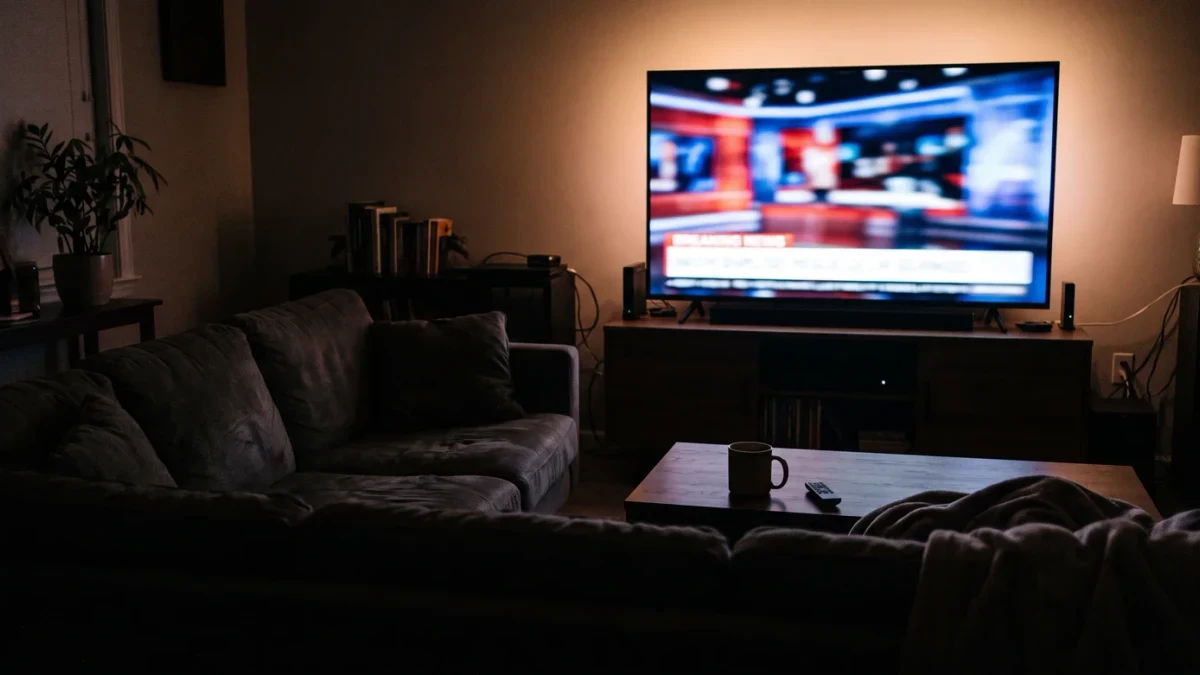
Cable news primetime is built for a business model in which the viewer is not the customer — the cable subscriber is, and the network's job is to justify carriage in a bundle most subscribers never chose per channel. The resulting programming logic, documented in the genre's whole history since the 1996 launch of Fox News and MSNBC's format pivot, optimizes for habit and intensity rather than breadth: a personality-driven opinion block whose audience returns nightly, producing the tune-in metrics that affiliate negotiations and advertising pricing use. That logic explains the format's durability and its current crisis: Nielsen's long series shows cable news audiences aging and shrinking, and the loyalty the format built is personal — to hosts — rather than institutional, which is why hosts who leave for streaming or independent platforms take measurable audiences with them, as Tucker Carlson's 2023 departure from Fox News and his subsequent independent show, and Mehdi Hasan's and Don Lemon's post-network ventures, each demonstrated.
What does the primetime format actually optimize?
Three measurable properties. Schedule adjacency: opinion blocks are arranged so that one show's audience flows into the next, with the 8-to-11 p.m. ladder managed as a portfolio — which is why a host change is a network-level event rather than a programming one. Emotional consistency: the research on partisan media, including political communication studies of outrage content, finds that affective consistency — the same villains, the same stakes, nightly — drives repeat viewing more than information value; the format is a serial, and its audience metrics reward serialization. And live-event spikes: breaking news and election nights deliver the large shared audiences that subsidize the format's economics, and their migration to streaming platforms removes the primetime ladder's highest-revenue nights.
Why did streaming platforms poach the format — and mostly fail at it?
The logic was sound, the execution instructive. Streaming services from 2019 onward (Fox Nation, CNN+, MSNBC's digital efforts, and various platform deals) assumed opinion audiences would follow hosts to subscription apps; CNN+'s 2022 shutdown weeks after launch became the industry's canonical lesson about willingness to pay a second subscription for content structured around a cable habit. The failures share a pattern: the cable format depends on passive, scheduled availability — the television is on, the show follows the previous show — and subscription apps demand active selection, which converts a habit into a decision. The successes inverted it: independent operations built on free, clip-first distribution (YouTube-first shows, podcast-audio versions) reproduce the adjacency economics of cable through algorithmic feeds rather than schedules.
What is happening to the audiences?
Splitting by age cohort, consistently. Pew Research Center's news consumption surveys track the generational cliff: television news generally, and cable specifically, retains majorities of older adults while younger cohorts get election information from streaming, social video and podcasts — the same surveys showing under-30 audiences largely absent from cable's nightly metrics. The loyalty model's arithmetic is therefore a slow demographic squeeze: the format's per-viewer value with older audiences is high (advertising for pharmaceutical and financial categories, subscription carriage), but each year's entrants to the news audience arrive through other channels, and the total addressable pool contracts with actuarial certainty.
What are the networks doing about it?
The documented strategies run from defensive to transformative. Digital subscription and streaming hybrids — Fox Nation, MSNBC's rebranding of its digital offerings, CNN's Max deal — treat the linear audience as a funding base for platform transition. Cost restructuring: the 2023-2025 rounds of programming cuts, host departures and scheduling experiments reflect linear revenue decline arriving at programming budgets. And personality arbitrage: networks pay selectively for hosts whose independent-audience risk they can least afford, accepting that the star system raises the exit threat it defends against. The honest summary is that no network has found the replacement for bundle economics; the current strategies manage decline while the audience sorts itself by platform.
What does the loyalty model leave behind?
A media system measurably different in kind. Cable primetime manufactured a shared nightly partisan space — the same monologue, the same outrage, at the same hour, for millions simultaneously; its successor platforms deliver individually scheduled feeds where two viewers of the same show may never share a live moment. The political communication literature treats that shift as consequential beyond ratings: the common-experience function that broadcast-era politics assumed is not migrating to the new formats, and the cable era's polarization effects were built on shared attention. Whatever replaces the loyalty model will not merely re-platform the content; it will re-structure how much of politics is experienced together at all.