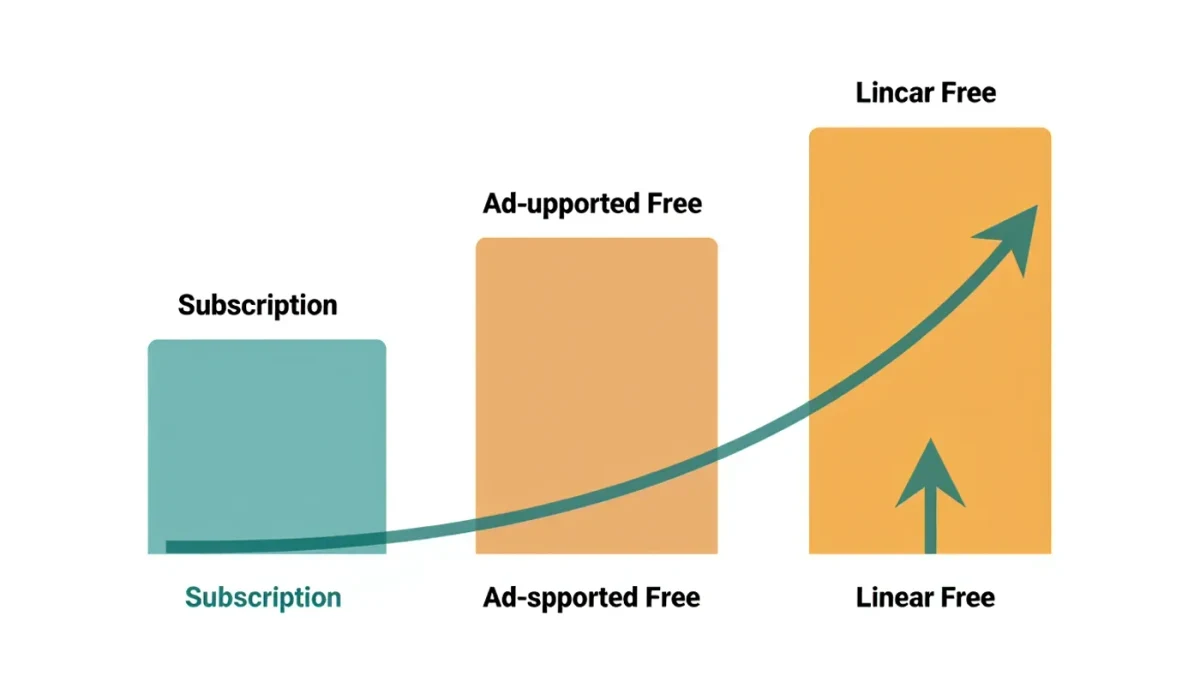
Ad-supported streaming tiers are the discounted subscription plans, introduced across the major services from 2022 onward, on which the platform serves advertising in exchange for a lower monthly price — and they have quietly become the center of video advertising economics. The disclosure record is explicit about scale: Netflix, which for years sold no advertising at all, reported in 2025 that its ad-supported plan accounted for over half of new sign-ups in ad markets and that advertising revenue was growing at a rate that led executives to project the business roughly doubling year over year. For advertisers, the arrival of premium long-form video with logged-in, measurable audiences filled the gap left by declining linear television; for news publishers, it repriced the video attention they sell against.
Why did the discounts work commercially?
Because an ad-tier subscriber is worth more than their subscription fee. The arithmetic: Netflix's ad plan has typically listed at roughly half to two-thirds of the equivalent ad-free price, while a heavy viewer can be served impressions worth several dollars per month at connected-TV CPMs, which have commonly run in the $20–40 range for premium inventory. The subscriber pays less and yields more, provided viewing hours are sufficient. The strategic consequence is that the ad tiers inverted the subscription logic — the cheapest plan became the most valuable customer per hour watched, which is why every major service has since steered new sign-ups toward it through default placement and pricing gaps.
What inventory did this create for advertisers?
A new middle category between YouTube's open creator inventory and linear television's declining, unmeasurable bulk: professional, brand-safe, long-form video with per-impression measurement and logged-in targeting. GroupM and Magna, the agency holding-company forecasters, have projected streaming overtaking or having overtaken linear television in total ad revenue by mid-decade — a crossover driven substantially by these tiers. The inventory also came with constraints advertisers learned only after buying: limited load (services launched with roughly four to five minutes per hour against linear's eight-plus), frequency caps that limit reach-building, and content libraries cleared for ads selectively, leaving sports and some licensed material as the scarcest, priciest units.
How does this affect news and media companies?
Three spillover effects matter. First, budget competition: every video ad dollar shifted to streamer tiers comes out of some other video budget, including news publishers' pre-roll and display-adjacent video, and the streamers sell reach plus measurement more efficiently than most news inventory can. Second, price anchoring: connected-TV CPMs set expectations for all premium video, compressing what news video can charge unless it sells context — coverage of a war, an election night, a market crash — rather than audience alone. Third, the bundle lesson: streamers demonstrated that a portfolio of engagement products (series, films, live sport) supports both subscription and advertising revenue on the same account, which is the model news companies cite when they bundle games, cooking and audio alongside journalism.
What are the risks in the ad-tier model?
Cannibalization and ad load tolerance. Subscribers who would have paid full price take the discount — the leakage every service manages with pricing architecture — and the temptation to raise ad load risks eroding the experience premium that distinguishes streaming from the linear television it replaces. There is also a measurement dependency: the tiers' value rests on logged-in data that privacy regulation keeps narrowing, and the industry's fallback currency, panels plus modeling, looks increasingly like the linear ratings it was meant to improve upon. The services with live sport and steady originals supply enough hours to absorb more ad load; those without will hit the same arithmetic that constrained television.
What should media analysts watch next?
Two disclosures. Ad-tier mix of new sign-ups, where Netflix's reporting discipline has forced competitors toward similar transparency, and ad ARPU per viewing hour, the number that will reveal how much load the services can actually add. The ad tier was introduced as a defensive answer to subscriber saturation; it has become the growth engine of the streaming business and the reference price for every seller of video attention, including the ones whose programming is journalism.
What did the ad tiers do to subscription pricing overall?
They reintroduced price discrimination that the streaming era had abandoned. Netflix's single-price years left money on the table — the same plan sold to a price-sensitive student and an indifferent professional. The ad tier captured the former at a lower price while advertising monetized their viewing, and the ad-free tier's subsequent price increases harvested the latter. The tier structure also created the industry's stealth rate rise: the headline price gap between ad-supported and ad-free plans has generally widened, pushing price-sensitive subscribers toward the ad tier and converting what began as a defensive discount into a segmenting machine. That is the mature playbook of every metered industry, arriving in streaming a decade late because the sector's growth phase did not need it.