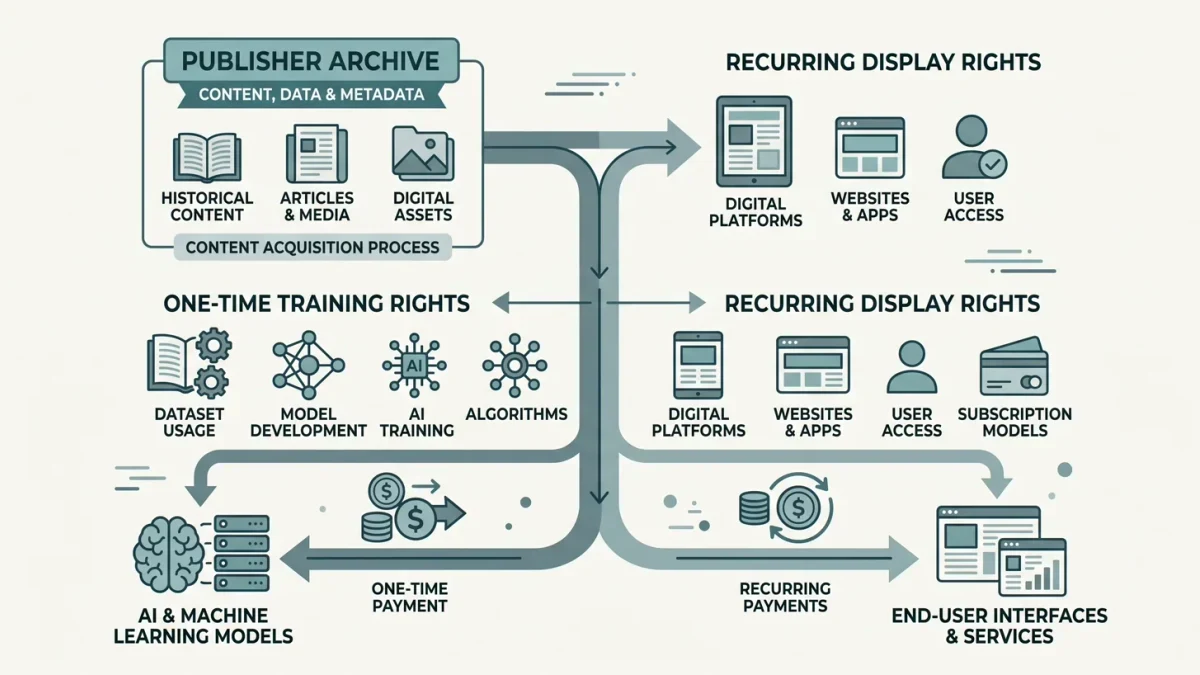
The AI industry's publisher problem has produced two distinct settlement models, and their divergence hardened through 2025-2026. OpenAI's approach is the flat-fee license: content access and display rights for negotiated sums — the reported hundreds of millions flowing to News Corp, Axel Springer, the Financial Times and others — which converts infringement risk into procurement. Perplexity's approach, launched with its publisher program in mid-2024, is revenue share: participating outlets — the announced partners have included Time, Der Spiegel, Fortune and others across subsequent expansions — receive a share of subscription and advertising revenue proportional to how often their content grounds the search engine's answers, plus access to subscriber-content syndication. One model pays for inventory; the other pays for usage. The usage model's honest appeal is alignment: the publisher earns when the assistant cites it, which at least prices the citation rather than ignoring it.
The litigation backdrop shaped both. Forbes and Wired banned Perplexity's crawler in mid-2024 after documenting its content use without permission; Dow Jones and the New York Post — News Corp titles — sued Perplexity in October 2024 for what the complaint called an unlawful content farm built on others' journalism; and the parallel line of copyright suits against OpenAI, anchored by the New York Times Company's December 2023 case, continued through discovery into 2025-2026. Perplexity's program arrived framed explicitly against that pressure: a way for publishers to be paid for what was being taken, without conceding the underlying legal question.
What does the revenue-share model actually promise?
Three things flat fees do not. Proportionality: payments track usage, so outlets whose reporting drives answers earn more than their size alone would command — attractive to specialized publishers whose per-article value exceeds their traffic. Data: partners receive analytics on how their content is cited and used, a transparency concession licensing contracts rarely include. And durability: a percentage has no expiry date the way a five-year flat fee does, avoiding the repricing cliff the early flat deals face. What it does not promise is scale: per-answer revenue shares divide a subscription price across every grounding source in every response — the arithmetic that produced the early payouts publishers and analysts described as modest relative to the traffic being displaced.
How do publishers evaluate the two models?
By leverage and patience. The large litigation-capable groups can command flat fees large enough to matter — which is why they mostly took OpenAI's checks — and several simultaneously joined usage programs where offered, taking both the floor and the upside. Mid-sized and regional publishers lack the suit, and revenue share is their only entry: the program's expansion cohorts through 2025 drew exactly that tier. The strategic reservation, voiced across the trade press, is the metric itself: usage share inside an answer engine whose totals the platform controls, measured by a methodology the platform writes — the same walled-garden measurement problem advertisers face in retail media. A percentage of what, verified by whom, is the question the program's fine print answers and the press releases do not.
What is the trajectory into late 2026?
Convergence from both sides. OpenAI's later deals added usage-contingent elements and product features — links and displays that make the citation visible — borrowing the alignment logic; Perplexity expanded its program and settled or narrowed portions of the News Corp litigation while the core fair-use questions headed toward rulings that will price everyone's leverage. The unresolved variable is legal, not commercial: if the training-and-retrieval cases establish that news content requires a license, the flat fees were bargains and usage shares will rise; if fair use covers the ingestion, both programs are charity the platforms can end. Publishers, meanwhile, keep doing the only thing that worked in every previous platform era: converting whatever audience the citations deliver into direct relationships before the terms change again.