Net neutrality is the principle that internet access providers should not block, throttle or prioritize traffic for payment — and its U.S. legal status has now changed party control four times in a decade. The operative precedent is the Sixth Circuit's January 2025 decision in Ohio Telecom Association v. FCC, which vacated the FCC's 2024 order reclassifying broadband as a telecommunications service under Title II of the Communications Act, holding that broadband providers do not offer telecommunications as defined by the statute. The ruling left the 2024 rules — the restore-and-safeguard framework the FCC adopted under Chairwoman Rosenworcel in March 2024 — unenforceable and returned the industry to the lighter-touch classification of the repealed 2017 order. For news publishers, whose distribution depends on unconstrained carriage, the practical stakes are real but indirect: the rules' absence removes a federal backstop rather than documenting current abuse.
What was actually at stake in the reclassification fight?
The statutory hook, not the conduct rules. Open-internet prohibitions — no blocking, no throttling, no paid prioritization — require the FCC to have jurisdiction over broadband, and the Communications Act's Title II (common carrier) is the classification that clearly provides it, as the DC Circuit's Verizon decision in 2014 established when it struck down earlier rules adopted under Title I. The Obama-era FCC reclassified in 2015; the Trump-era FCC reversed in 2017; the 2024 order reversed again; the Sixth Circuit vacated. Each swing is a change in legal architecture around conduct rules that, in practice, no major U.S. provider has recently been documented violating at scale — which is why the debate is fought on infrastructure-investment and jurisdictional grounds rather than on case files.
What did the Sixth Circuit actually hold?
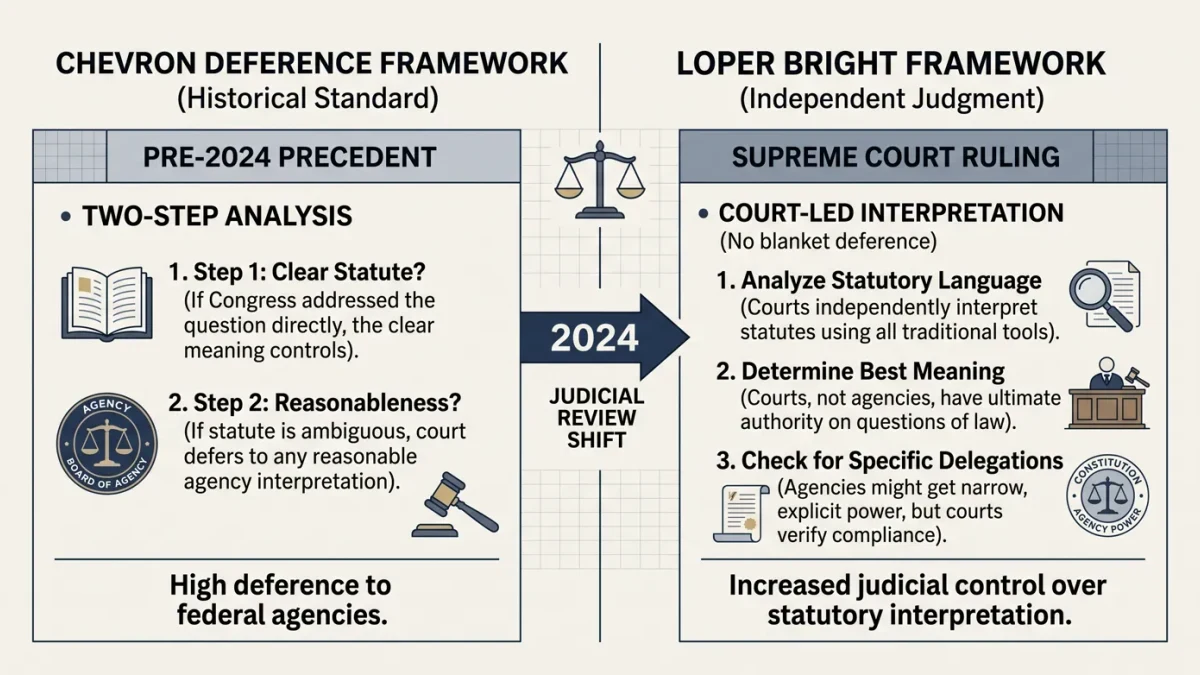
That the act's definitions control: offering broadband, the majority reasoned, is offering an information service integrally bound to computing functionality — domain name resolution, caching, email — and therefore not the transparent transmission of information without change in form or content that defines telecommunications. The opinion declined to defer to the FCC's contrary reading under the major questions doctrine's shadow, following the Supreme Court's Loper Bright (2024) displacement of Chevron deference: courts, not agencies, decide what the statute means. The consequence is structural: unless Congress amends the act or the Supreme Court takes a future case, reclassification is not merely disfavored but foreclosed in the Sixth Circuit's territory — and by precedent's force, nationally while the ruling stands.
What rules govern now?
A patchwork with the federal layer absent. State net neutrality statutes — California's SB 822, the strongest, plus Washington's and others' — remain in force, and the Justice Department's Biden-era withdrawal of the California challenge left them durable; enforcement, however, reaches only conduct affecting those states and falters on interstate questions. The FCC retains narrow authority over specific harms through other statutes and its public-safety and equipment-authorization levers, and the FTC's unfair-practices jurisdiction covers deceptive throttling claims — the theory applied in prior cases against carriers misrepresenting unlimited plans. For a news outlet, the operative protections against carrier interference are now contractual, state-level and reputational, with the last being historically the strongest: no major U.S. carrier wants the scandal of throttling a news service.
Why should media policy readers care?
Because carriage is upstream of content. The net neutrality fights were the first round of a broader question now reprised around AI: whether the companies controlling distribution infrastructure — then ISPs, now model providers and assistant interfaces — can favor their own or paying content. The Sixth Circuit's definitional holding (transmission with computing integrated is not common carriage) maps directly onto disputes over whether AI assistants that summarize rather than link are exercising editorial or carrier functions. The 2015-2025 cycle's lesson for that fight: conduct rules last only as long as their statutory foundation, and foundations built on contested definitions get relitigated with every administration.
What happens next?
Realistically: stalemate until Congress acts, which it has declined to do through five administrations of both parties. The Commission under its current composition will not re-reclassify against the Sixth Circuit's holding; state regimes will thicken; zero-rating and interconnection disputes will surface case by case before the FTC and state regulators. The honest summary for readers tracking information policy: the open internet in America is currently a market norm guarded by state statutes and publicity, not a federal rule — and it has been for most of the last decade.