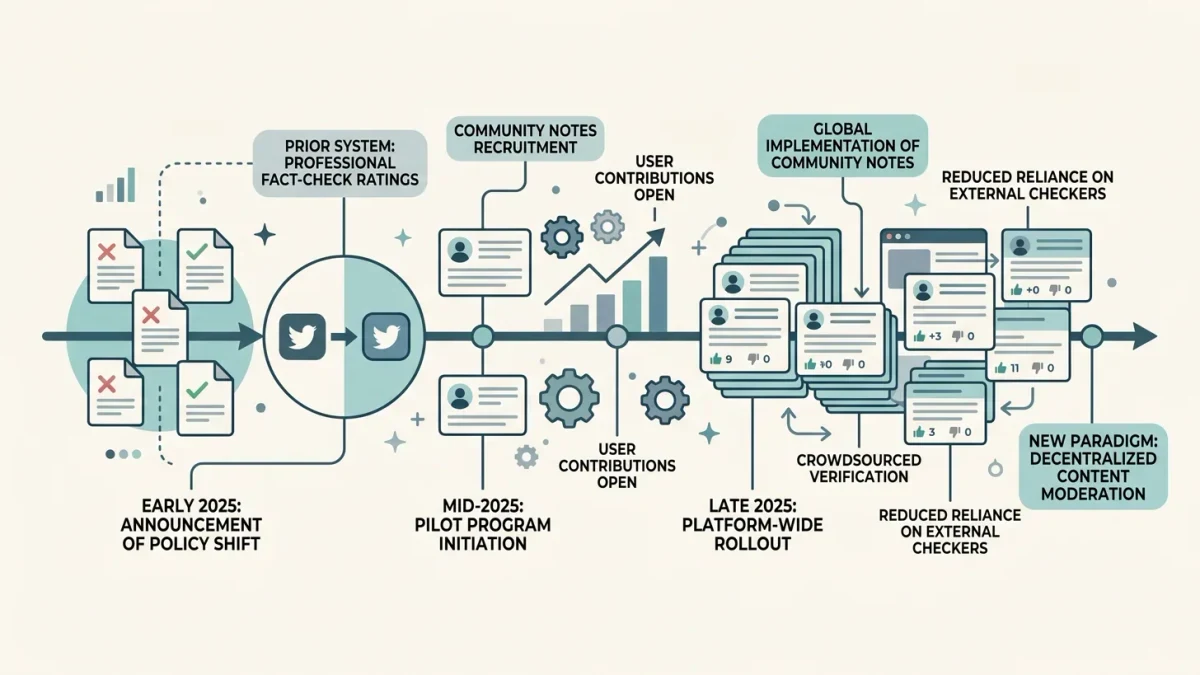
The professional fact-checking field marks January 2025 as its structural break: Meta announced it would end its third-party fact-checking partnership program in the United States, replacing it with a Community Notes model, and the company's founder stated the change explicitly in policy videos and posts. The program had been the field's single largest funding source — Meta's contracts with dozens of certified organizations across the world financed a substantial share of global fact-checking capacity — and its end, paired with the loosening of several platform content policies, forced a sector-wide restructuring that is now visible in what fact-checkers actually do.
The rebuilding followed three documented paths. Election focus: the surviving organizations concentrated capacity on electoral verification — debate claims, viral election misinformation, candidate records — where funders' interest remained, following the model of coalitions like the one U.S. fact-checkers ran in the 2024 cycle. Artificial intelligence: fact-checking units adopted AI tools for claim detection and transcription triage while adding a new beat — verifying synthetic media and AI-generated political content — expanding on work documented since the January 2024 New Hampshire robocall case. And revenue diversification: reader memberships, philanthropy and newsroom integration replaced platform contracts, a transition the International Fact-Checking Network — the certifying body at the Poynter Institute — discussed openly as its members' Meta payments wound down.
What did the Meta years actually build?
An infrastructure that outlived its patron. The third-party program, launched in 2016 after the U.S. election misinformation controversies, trained organizations in platform-specific workflows, standardized ratings and created the certification network that now defines professional practice. Whatever the program's modest measurable effect on virality — academic assessments were tepid — it financed standing capacity: journalists who could be redeployed rather than hired from scratch. The organizations that survived the funding cliff best were those that treated Meta income as a contract, not a budget line, and the casualties were concentrated in the Global South operations that had the fewest alternative funders, as reporting on post-cut closures and downsizing documented through 2025.
What replaced fact-checking on the platform?
Community Notes — the crowdsourced annotation system Meta adopted, modeled on X's implementation, in which volunteer notes attach context to posts and appear once raters across viewpoints rate them helpful. The swap is a philosophical change, not merely a vendor change: professional verification is replaced by structured crowd judgment, with Meta's stated rationale emphasizing reduced censorship risk and scalability. Researchers' comparisons of the two systems — including studies of X's Notes published by the Community Notes research community — find the crowd system accurate on what it notes, but slow, coverage-sparse relative to flagged volume, and dependent on the alignment of its contributor base. The platforms' trade, in short, exchanged professional throughput for legitimacy among skeptics of moderation.
What is the honest assessment of the field's effect?
Narrower than either critics or proponents claim. The research record finds fact-checks can correct beliefs when the recipient encounters them, with effects weakened by selective exposure and motivated reasoning; the platforms' internal data and external audits during the Meta years showed fact-checked content's reach reduction was real but small at the system level. Fact-checking's durable contributions are archival and journalistic — a public record of claim adjudication that journalists, libraries, courts and now AI assistants draw on. That last use is the sector's quiet second life: retrieval systems cite fact-check records, making the archive's maintenance valuable to an industry that stopped paying for it.
A year on, the field is smaller, more election-focused, and structurally independent of the platforms it once audited. The gap Meta left on the platform side is being tested by the crowd; the gap in global verification capacity, especially outside wealthy media markets, is simply open — and the closure notices in those markets, not the American policy debate, are where the exit's cost is being paid.