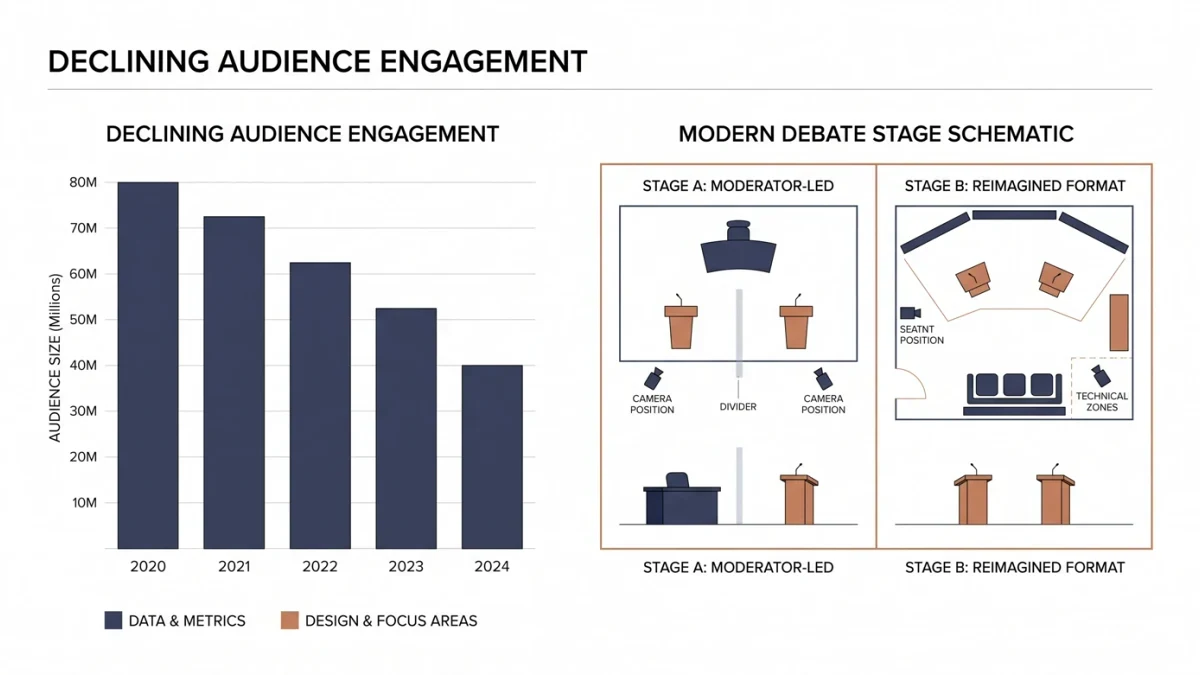
Two changes hit televised debates at once: the audience declined and the meter changed. The decline is well documented in Nielsen's reported totals — the first general-election debate of 2016 drew roughly 84 million viewers on linear television, while the 2024 cycle's debates and the vice-presidential matchup each reported audiences in the 40-to-55 million range across linear and streaming — roughly half the mass-event status of a decade earlier. Meanwhile the measurement itself was rebuilt: Nielsen spent the mid-2020s transitioning national ratings from a pure people-meter panel toward a big data plus panel methodology combining set-top box and automatic-content-recognition data from millions of homes with the traditional panel, after industry pushback delayed its adoption as the sole currency. A campaign reading its debate numbers is therefore reading a different instrument than campaigns used before.
Why did debate audiences shrink?
Decline of the appointment, not of interest. The debates' mass-audience era assumed three broadcast networks and shared prime time; in the fragmented present, viewers who once watched together now encounter debates as clips — the exchange clipped within minutes, distributed on social platforms, and consumed by multiples of the live audience after the fact. Nielsen's own multi-platform measurement attempts and the campaigns' internal clip metrics both suggest the post-debate clip audience is larger than the live one for younger cohorts. The political consequence is subtle: the debate's persuasive function has moved from the event to its editorialized fragments, chosen by staff and supporters rather than producers — which is why spin-room effort migrated to clip packaging.
What does big-data measurement change?
Precision and its discontents. Panel-only ratings extrapolated from tens of thousands of households; big-data ratings observe return-path and ACR signals from millions, catching viewing the panel missed — especially in non-white, younger and rural households historically underrepresented. The tradeoffs the industry's Video Advertising Bureau and networks litigated through the transition were calibration and representation: big data overcounts some contexts (sets on in empty rooms, unless paired with panel adjustment) and the fusion of datasets introduces its own modeling. For news specifically, the shift can materially move reported audiences for cable news dayparts, because background news viewing — sets on for hours — is exactly the viewing ACR observes differently than a person pressing a people-meter button.
Why do campaigns still manage by debate ratings?
Inertia and comparability. The rating is a public, third-party number that news coverage itself amplifies — the morning-after audience story is itself coverage — and internal campaign research cannot match its authority. But the numbers' meaning has quietly inverted: a smaller live audience means the debate's direct persuasive reach is limited to the politically engaged residue, while the persuasion that matters happens in the clip economy the ratings do not measure. Campaigns that understand this treat the live event as content generation for the fragments; the rating is a lagging indicator of how much raw material the event produced.
What should newsrooms do with debate numbers?
Report them with their instruments named. The honest form is: live linear audience per Nielsen, streaming additions where counted separately, and clip distribution where the platform data exists — three numbers, not one. Stories that compare 2026 figures to 1980s records without noting the methodology change are comparing different measurements; stories that treat the live rating as the debate's reach understate it, and stories that ignore demographics miss that the residual live audience skews older and more partisan than the electorate. The debate is still the campaign's largest single scheduled audience; the error is reading that audience through a meter pretending it is 1992.
What does the ratings shift do to the events themselves?
It changes what a debate is for. When the mass audience was live, the event targeted the median voter — persuade the undecided watching in real time, avoid gaffes that evening news would replay. In the clip era the target has split: a smaller live audience of partisans who reward confrontation, and a larger post-event audience that encounters only the exchanges chosen for virality. Campaigns now rehearse for the clip — the prepared line, the visual moment, the exchange engineered to be excerpted — because that is where the audience measurably is. The commission's format reviews have wrestled with exactly this drift, and the moderators' recurring experiments with fact-checking in real time are an attempt to move verification into the moment the clip captures rather than the day after. None of it restores the appointment audience; it adapts the institution to a distribution layer the 1960 format designers never imagined.