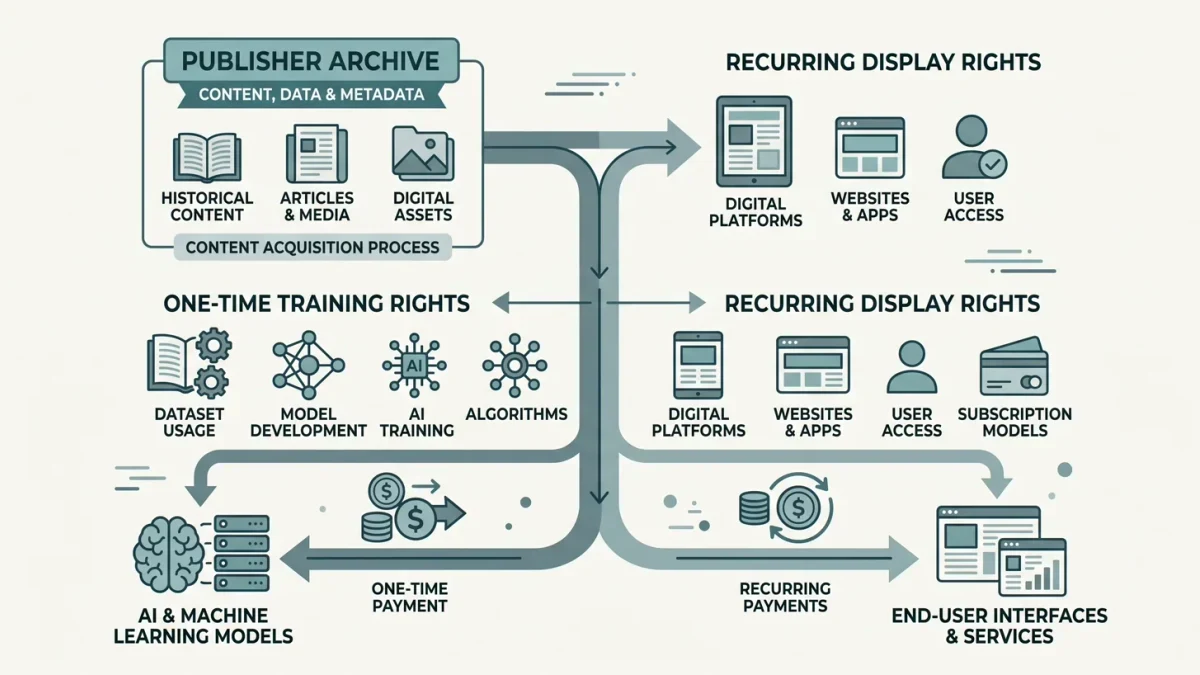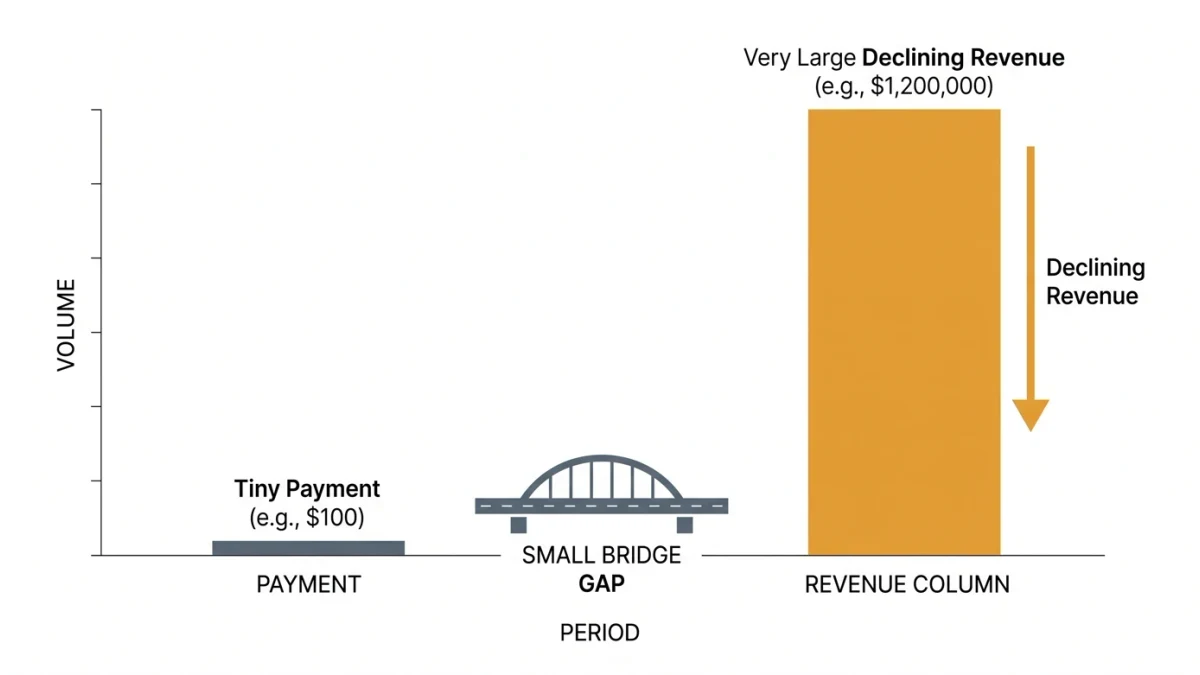
Direct payments from platforms to news publishers — licensing deals, partnership funds and regulatory settlements — constitute a real but modest revenue stream whose total scale is far below the value of the advertising and referral relationships they nominally compensate. The most concrete documented figures come from regulatory processes: Australia's Treasury reported that the News Media Bargaining Code framework, legislated in 2021, produced agreements worth an estimated 200 million Australian dollars annually before markets shifted; Google's licensing programs, including the 2020-launched Google News Showcase, committed a reported 1 billion U.S. dollars over three years across many countries; and Meta's 2019-2021 news partnerships in the U.S. ran to a reported 105 million dollars before the company wound them down. For context, U.S. newspaper advertising revenue was roughly 9.8 billion dollars in 2022 per Census Bureau data — meaning all platform payments together amount to a rounding error on the industry's lost advertising base.
Why did the platforms start paying?
Three successive logics. The first was reputational preemption: Facebook's 2019 news investments and Google's Showcase followed years of publisher hostility and antitrust scrutiny, paying publishers before governments compelled payment. The second was regulatory flight: when Australia's code and Europe's neighboring-right regime created credible extraction mechanisms — arbitration under the Australian code, copyright collective licensing under the 2019 EU directive — the platforms struck deals to avoid designated status. The third was product need: the rise of generative AI created genuine licensing demand for training and retrieval content, converting what had been charity-adjacent partnership spending into procurement. The through-line is that none of these logics made publisher payment a core platform cost; each was a buyout of a specific political risk, which is why the payments were among the first expenses cut when the risk changed.
What happened when Meta exited?
The sequence is instructive. Facebook wound down its U.S. news tab and partnerships in 2023-2024, ended news availability in Canada in response to the Online News Act, and did not renew most Australian deals as they expired through 2024-2025, dropping the dedicated news products along with the payments. The consequence documented in traffic analyses was a permanent reduction in social referral to news — accelerating a decline already underway as feeds deprioritized links — and a transfer of bargaining attention from Meta, which had left, to Google, whose search referrals remained indispensable. The lesson embedded in the exit is the asymmetry the Australian code was built to address: a platform can absorb the loss of news content; publishers cannot absorb the loss of distribution, and payments that substitute for distribution economics collapse when the distributor leaves.
What did the money buy platforms politically?
Time, mostly, and it was cheap. The deals repeatedly arrived precisely when legislation advanced: Australia's code in 2021, Canada's act in 2022-2023, California's Journalism Preservation Act negotiations mid-decade. Each time, the announcement of voluntary agreements split the publisher coalition — large recipients preferring guaranteed money to uncertain arbitration outcomes — which is a documented feature of the Australian and Canadian episodes, where the largest groups signed first and smallest outlets were left to collective mechanisms. Payments also functioned as an argument in antitrust proceedings: companies could point to licensing programs as evidence that market negotiation works without statutory intervention.
Is the AI licensing wave different?
In one respect, yes: AI developers need content as an input to products that compete with news consumption directly, so the payment is procurement rather than politics. The disclosed deals — OpenAI's agreements with the Associated Press, Axel Springer, Financial Times, News Corp and others, with News Corp's reported at more than 250 million dollars over five years — are individually larger than most social-era partnerships and are tied to product features like attribution and links. In another respect, no: the payments still flow to the largest publishers with the litigation budgets to credibly sue, they are confidential in most terms, and they leave the smallest outlets — the local papers whose closure drives the news-desert problem — outside the licensing economy entirely.
What is the durable policy lesson?
That payments negotiated under threat are cheaper than the value transferred, and expire with the threat. The supports that actually changed publisher economics at scale — subscription infrastructure, nonprofit models, tax credits like the payroll subsidies enacted in Canada and several U.S. states — did not depend on a counterparty's generosity or a platform's product roadmap. Platform payments were a bridge built by lobbying; the industry's problem is that the far bank keeps moving.