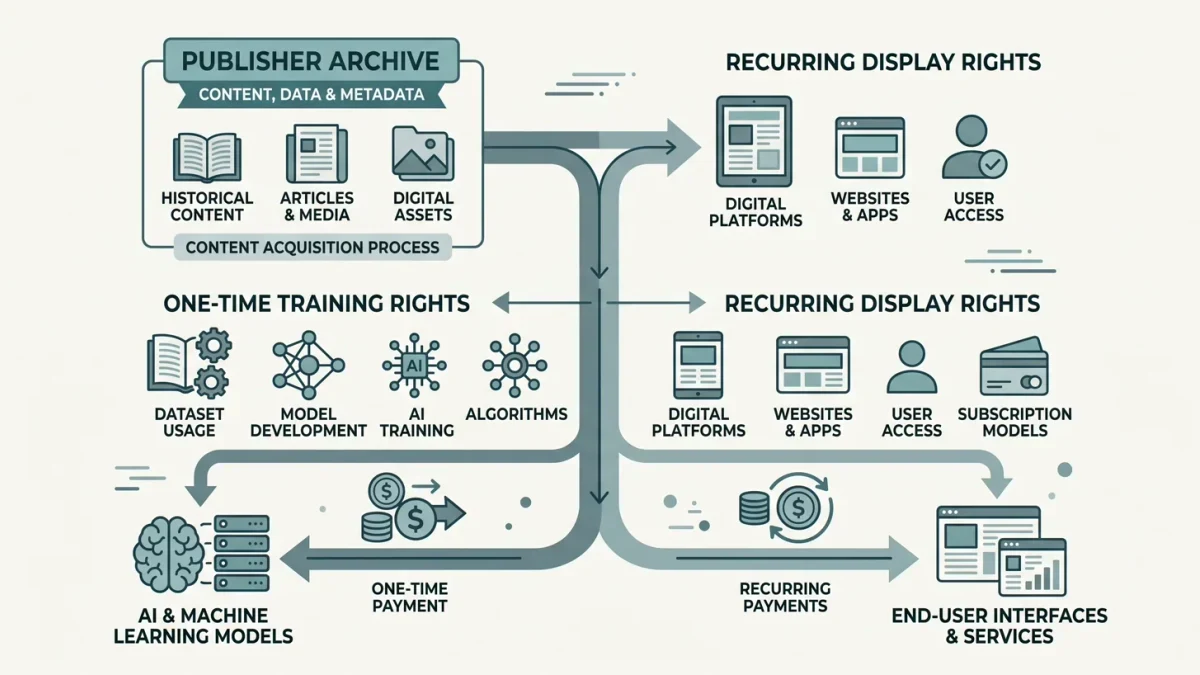
News publishers' licensing agreements with artificial-intelligence companies have become the industry's most consequential new revenue line: OpenAI alone announced content deals from 2023 onward with the Associated Press, Axel Springer, the Financial Times, Le Monde, News Corp, Hearst, Condé Nast and many others, with the News Corp agreement reported at more than 250 million dollars over five years and Axel Springer's reported at comparable annual scale for its German and U.S. titles. The precise figures are mostly confidential — press reports and company statements are the disclosure — and that fact shapes everything else: a market where the two largest sellers (News Corp, Axel Springer) set reference prices privately, and every smaller publisher negotiates without knowing them.
What do the deals actually license?
Two distinct products are frequently conflated. Training licenses cover the use of archives to train models — a one-time-ish extraction whose marginal value to the AI company declines as frontier models are trained. Product licenses cover real-time retrieval and display: the AI assistant searches or is fed current articles and cites them, which is an ongoing distribution relationship closer to syndication. Most announced deals bundle both without distinguishing them, which obscures the strategic question: training rights monetize the past, retrieval rights allocate the future traffic. Publishers that sold both for a flat fee traded a perpetual asset for a term-limited payment — defensible as portfolio management, questionable as pricing.
Who gets paid — and who does not?
The distribution is steeply concentrated. The reported deal values cluster among large, litigation-capable groups: News Corp, Axel Springer, the Financial Times, the AP. Regional chains and local newspapers have largely struck no direct deals, partly because their collective value to a model is diffuse and partly because they lack the credible copyright suit that drives settlement pricing — the backdrop to every major negotiation being pending litigation, including the New York Times Company's December 2023 copyright suit against OpenAI and Microsoft, and the consolidated proceedings before federal courts in New York. The market's structure is therefore: litigation threat converts to licensing revenue at the top, and below the top tier the same content is ingested through intermediaries, syndication resellers or without payment at all.
What are the risks publishers are accepting?
Three, documented in the trade-offs the contracts carry. Cannibalization: retrieval answers that satisfy the reader's question with a citation reduce click-through, and the publishers' own analytics of AI referral — where licensing deals include links — show volumes that are a small fraction of classic search referral. Pricing against uncertainty: the value of an archive to a model trained years from now is unknowable, so a five-year flat fee transfers option value to the buyer. And standardization: once several major publishers license on similar terms, the emerging norm becomes the market price for everyone else — the reason smaller publishers' associations in Europe have criticized the large deals as setting a low anchor.
What do the AI companies get strategically?
Clean data and legal peace. The litigation risk of mass ingestion of copyrighted news — the question at the heart of the Times suit and the Authors Guild line of cases — is converted by each deal into a paid license that also functions as precedent: a paid license implies a right that needed payment. The companies also get brand association with trusted outlets at precisely the moment their products' credibility is the binding constraint on adoption — citation of the Financial Times inside an assistant is a quality signal the assistant cannot otherwise buy. Both sides, in other words, are purchasing something more valuable to them than money: the AI firms buy legitimacy, the publishers buy revenue that arrives before the traffic declines it accelerates.
What should determine a publisher's answer?
The discipline the best-negotiated deals share: separate training from retrieval and price them differently; keep term short with value-based reopeners rather than five-year flats; require display formats that preserve branding and links; and retain the right to say no to specific products. The deals that look weakest in retrospect are the early ones — large archives, long terms, bundled rights, prices set before anyone knew the retrieval market's size. As with platform payments a decade ago, the first-mover publishers set precedents under maximum uncertainty, and the industry's later bargaining position is being set in those conference rooms now.