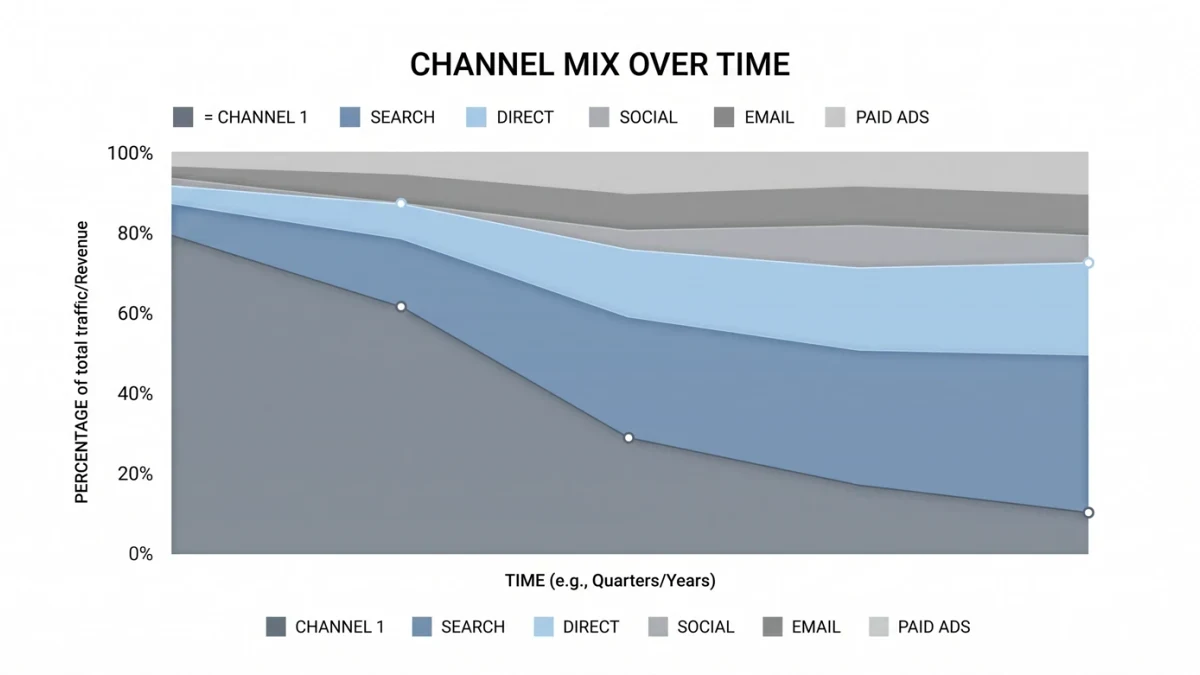
Meta's withdrawal from news distribution, completed in stages from 2023 through 2025, has ended the era in which Facebook traffic was a meaningful line in publisher analytics. The company retired its dedicated News tab in most markets, declined to renew the publisher partnership payments it had struck in 2019-2021, and blocked news links for Canadian users in response to the Online News Act — a blockade it maintained until agreeing in 2025 to lift it under the terms of a government settlement that included payment commitments, as reported by the Canadian Broadcasting Corporation and Reuters at the time of the agreement. The strategic consequence inside news companies is not disputed in any traffic dataset: social platforms now deliver a small fraction of the referral volume they carried a decade ago, and direct and search channels bear nearly all acquisition.
The exit's business logic was stated plainly by Meta executives over several earnings calls: news is a small share of what users consume on the platform, carries disproportionate political risk, and generates minimal engagement relative to short video and creator content. The partner payments — which included a reported 105 million dollars in U.S. deals — were wound down as each agreement expired, without replacement. What the company kept was the regulatory exposure calculation: in Canada, the initial ban cost publishers measurable referral traffic; in Australia, Meta's refusal to negotiate fresh deals under the News Media Bargaining Code prompted a government designation review and, eventually, negotiated accommodations.
What did the Canadian reversal prove?
That platform exits are reversible only by statute plus sustained political pressure. Meta restored news access not because the product calculus changed but because the alternative was a designation process with mandated arbitration — the mechanism Australia pioneered. For publishers, the Canadian sequence established that a government willing to hold the line can extract restoration and payment; for platforms, it confirmed that most governments will not.
How have publishers restructured around the loss?
Three documented shifts. Referral diversification: newsrooms report direct traffic, newsletters and search — including AI-search referrals, for those whose licensing or indexing deals include them — as the growth channels, with social reduced to distribution of individual journalists' brands rather than institutional pages. Cost rationalization: the social-video teams built for platform-native formats during the partnership years were among the first cut in the 2023-2025 industry layoffs, since the distribution guarantee behind them disappeared. And licensing emphasis: with traffic no longer purchasable through platform participation, publishers' platform-facing strategy consolidated onto AI licensing and registry-style deals where content itself is the product.
The underweighted consequence is competitive. Outlets that treated Facebook traffic as an audience — building followings on rented land — lost an asset they cannot rebuild; outlets that treated it as a channel — converting borrowed readers to subscribers — lost a funnel, which is recoverable. The exit, in other words, did not merely remove traffic; it sorted publishers by which of the two they had actually been doing all along, and the industry's current subscription-first, direct-first orthodoxy is partly the codified lesson of that sorting.