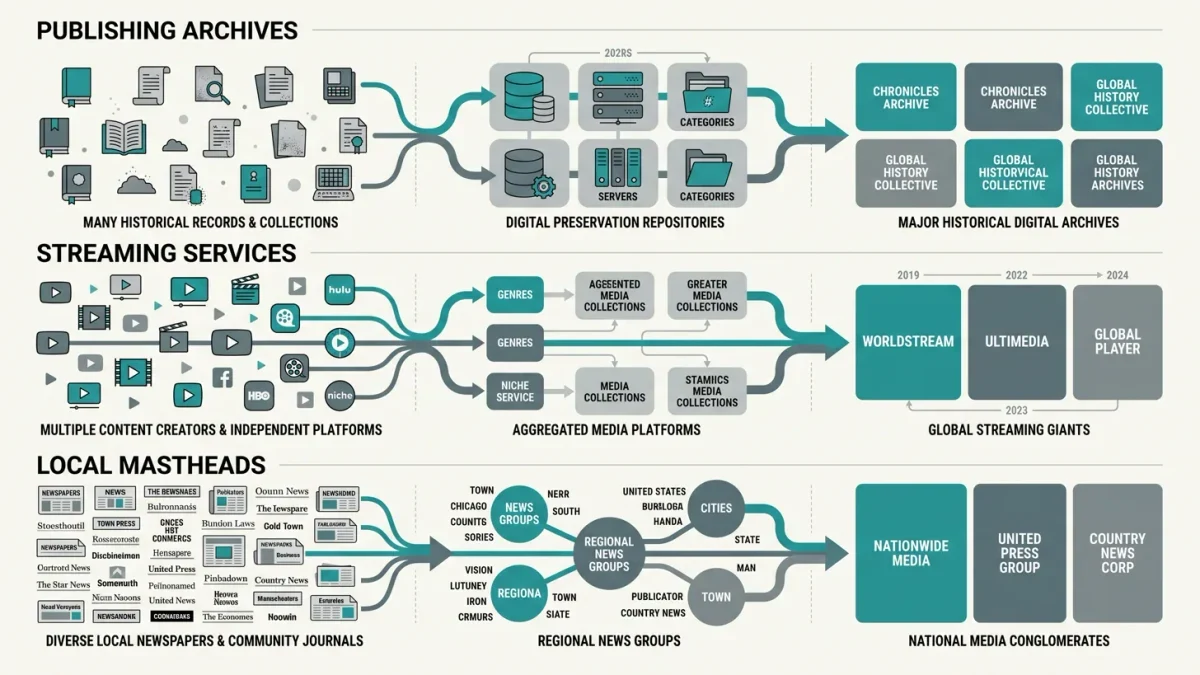
Two ownership models dominate what remains of American daily newspapers, and their financial filings describe the same strategy in different dialects. Gannett — the largest chain, publisher of USA Today and more than two hundred dailies after its 2019 GateHouse merger — is publicly traded, and its investor communications emphasize debt paydown, digital subscription arithmetic and, from 2024 onward, resumed dividends and buybacks funded by cost reductions. Alden Global Capital — the hedge fund whose MediaNews and Tribune holdings include the New York Daily News, The Denver Post and scores of regional papers — is private, but its strategy is visible in outcomes: newsrooms cut to fractions of former size, shared editorial production across states, and real estate sales, with the Denver Post's own editorial board famously documenting the extraction in a 2018 denunciation that remains the genre's defining text. The publicly documented common result: declining revenue, far faster declining costs, positive free cash flow, and a shrinking report.
What does the Gannett arithmetic look like?
Like a controlled liquidation with a subscription narrative. Gannett's revenue declines annually — print advertising and circulation fall faster than digital subscriptions rise — while adjusted profitability is maintained through successive cost programs: centralization of printing, shared editing hubs, reductions in each annual plan. The company's stated pivot targets digital-only subscriber growth and events revenue, and its disclosures report progress on those metrics alongside continued total revenue decline. The strategic bet is that the core stabilizes at a smaller size with a loyal paying audience; critics, including the NewsGuild locals representing its newsrooms, argue the cost base is cut past the point of product quality, making the stabilization self-defeating. Both descriptions are accurate; they disagree about the equilibrium.
What does Alden's model add?
Speed and indifference to journalism's reputational economy. As a private fund with fiduciary duties to investors rather than public-market optics, Alden can cut deeper and faster: entire Washington bureaus closed, papers consolidated into regional clusters with shared staffs, and — as press investigations of its investor materials documented — returns generated substantially through cost reduction and asset sales rather than revenue growth. The company's proposed acquisition of Lee Enterprises, if completed, would extend the model to another large chain. What Alden demonstrated for the industry is that newspaper cash flows, properly farmed, sustain extraction for years: the asset declines but the yield during decline is real, and the buyer of last resort sets the market price for every distressed daily.
Why doesn't competition fix this?
Because the newspapers' market position, not their ownership, defines the cash flows. A metro daily's franchise — brand, print habits, local advertising relationships — decays on a schedule set by the internet, not by management quality; an owner who reinvests earnings into newsroom capacity produces better journalism on the same declining revenue, and earns a lower return than the extractor. Economists describe this as a harvesting equilibrium: the highest-value use of a declining annuity is to harvest it, and the market for newspaper assets selects owners who will. The counterexamples — owner-patrons who subsidize quality, nonprofit conversions — are exactly the cases where the owner has opted out of the return competition.
What do the filings mean for readers?
A reading protocol. When a chain reports record adjusted EBITDA alongside a smaller newsroom, both numbers are true and the second explains the first. When a hedge fund offers a premium for a publisher, the premium is a forecast of cuts whose present value exceeds it. And when any owner announces a digital pivot, the test is the renewal cohort data and the editor-to-writer ratio in three years, not the launch press release. The newspaper business's remaining public-market season is a negotiation between owners harvesting cash and communities absorbing the externalities — and the negotiation's terms are set in disclosures most readers never see.
Is there an end state?
Two, running in parallel. In the harvesting track, chains converge on clusters of thin operations around printing plants and digital-only brands with minimal staff — sustainable at very small scale indefinitely. In the exit track, individual properties convert to nonprofit ownership, local buyers or closure, and the pace of that track is set by philanthropic capacity rather than market logic. The Gannett-Alden era ends not with a liquidation event but with a residue: a set of mastheads that persist as brands while the functions they once performed — coverage of courts, schools, city halls — are either funded some other way or not performed.