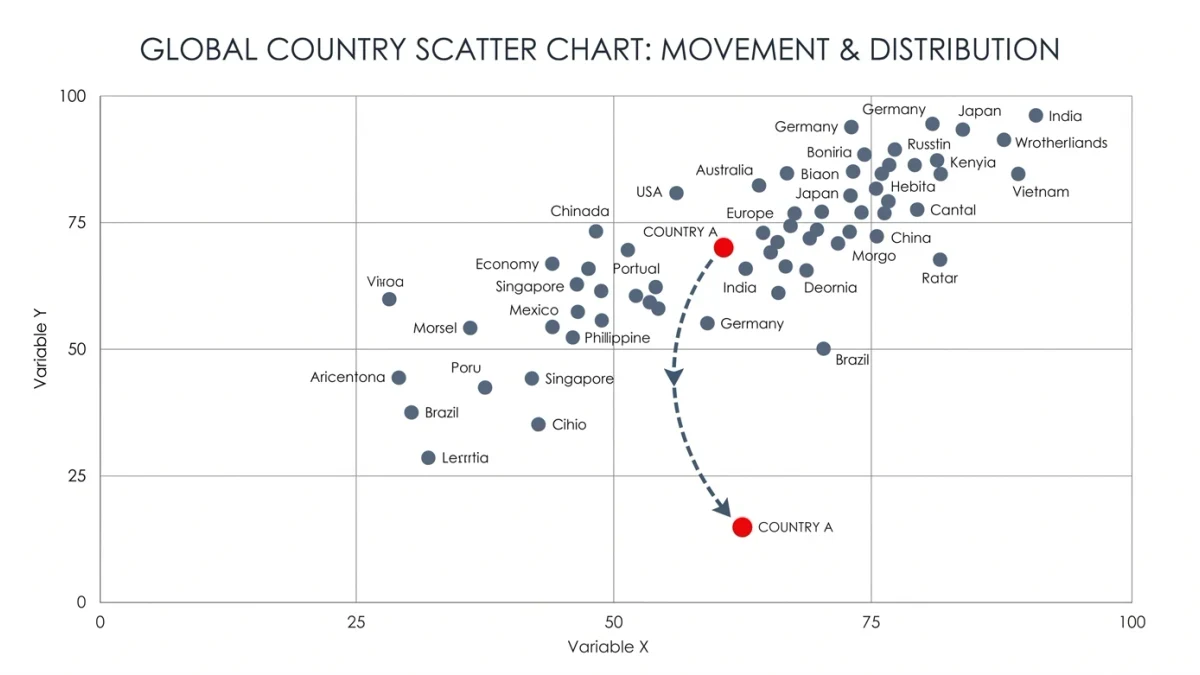
The two global press-freedom scorecards move in the same direction on the United States, and their mechanics deserve as much attention as their headlines. Reporters Without Borders's World Press Freedom Index placed the U.S. in the low forties to mid-fifties in the mid-2020s — down from its top-25 positions a decade earlier — with the 2025 index reporting a sharp further drop that RSF attributed substantially to the political environment: actions against journalist associations, refusals of access, and an atmosphere in which the index's methodology registered both material deterioration and worsened perception. The Freedom of the Press index, published from 2001 to 2022 by Freedom House before its methodology was retired into other research, had already downgraded the U.S. from Free status on similar grounds. These are real measurements of real changes — and they are also constructed instruments whose inputs and weights determine what a movement in the ranking means.
What do the indexes actually measure?
Different things, which is why they disagree at the margins. The RSF index, since its 2022 methodology revision, is a hybrid: quantitative indicators of abuses (journalists killed, jailed, attacked — compiled from documented cases) combined with a qualitative survey of press-freedom specialists scoring political, economic, legal, social and security contexts. The survey component means expert perception, aggregated across hundreds of respondents, is a majority of the score — so the index measures the environment as experienced and judged by informed observers, not a census of outcomes. Other scorecards — the Committee to Protect Journalists's case counts, the press-freedom tracker maintained by Freedom Coalition partners documenting assaults, detentions and equipment seizures in the U.S. — are pure incident data, narrower and harder.
What drove the U.S. decline?
The documented components, in the indexes' own published rationales: physical risk and hostility toward journalists during the 2020-2024 period, tracked by the U.S. Press Freedom Tracker's counts of assaults and arrests at protests; legal and governmental pressure, including leak prosecutions under the espionage-era statutes, subpoena practice, and the 2025-era episodes involving litigation against journalist organizations and access restrictions; economic preciosity, which the RSF economic sub-index treats as a press-freedom variable — ownership concentration and newsroom collapse lower the score; and the political climate variable, where rhetoric treating the press as an enemy registers directly. Notably, the U.S. has never scored poorly on the legal-framework component in the way authoritarian states do — the First Amendment remains the world's strongest textual protection — and the decline reflects the other four dimensions.
What can the rankings not tell you?
Three things. Magnitude across countries: the difference between rank 30 and rank 55 can be a few decimal points on a compressed scale, and the U.S. remains categorically distant from the jailing states — no American journalist is serving the long prison terms that define the index's bottom tier. Within-country causes: a fall driven by survey perception behaves differently from one driven by incident counts, and the hybrid score does not publish the decomposition prominently. And counterfactuals: the index records direction, not attribution — how much of a given year's movement reflects events, and how much reflects the intensity of expert attention on the country that year, is not separable from the outside.
How should newsrooms use them?
As documented event inventories and as early-warning instruments, not as report cards to quote without method. The defensible use: cite the specific incidents the indexes and trackers compile — the arrests, the subpoenas, the access decisions — because those are checkable facts with dates. The defensible caution: when citing the rank, name the instrument and its survey component, and resist the partisan uses both directions — the ranking as proof of authoritarianism (overclaiming what a perception-weighted score establishes) or as proof of bias (ignoring the documented incidents underneath the perception). The index's real function in a healthy system is not the number but the pressure: governments do not like falling, and the documented cases the score rest on have historically generated more response than the rank itself.
What should observers watch going forward?
The hard indicators, which move slowly and mean the most: the Press Freedom Tracker's counts of detentions and assaults; subpoena and forced-disclosure practice in the courts; the accessibility of government to journalists — credentialing, pool access, answering questions — which the post-2025 environment has stressed; and the leak-prosecution docket. Those numbers, not the rank, are the American press-freedom record being written, and they are public enough for any reader to consult directly.