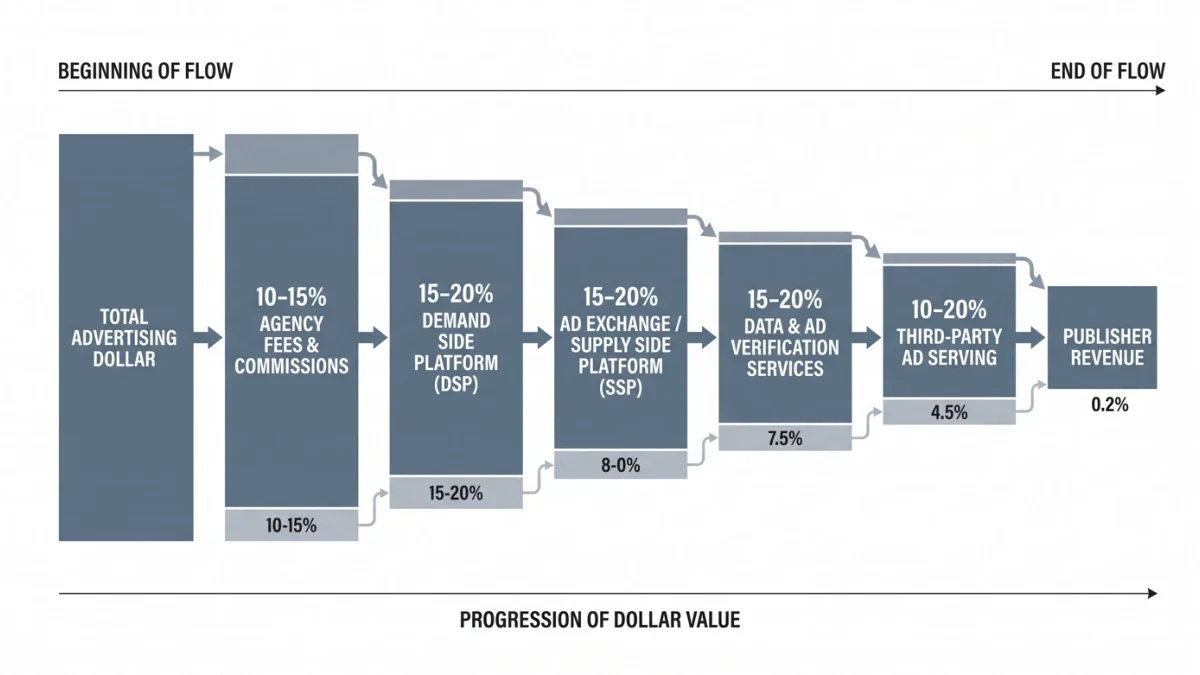
When an advertiser buys a news website's inventory through programmatic channels, the publisher typically receives a minority of the money the advertiser spent. The most cited industry audit — the 2023 study by the Association of National Advertisers, conducted with Ebiquity and covering some $22 billion in spending — found that publishers received on average about 36 cents of every programmatic dollar once intermediaries took their margins, with roughly a quarter of spend classifiable as having no clear value at all under prior audit definitions. For news publishers, whose display business is largely programmatic, that supply chain is not an abstraction; it is the difference between a sustainable ads operation and one that runs at a loss on its own inventory.
What sits between the advertiser and the publisher?
A typical open-web impression passes through several hands: the advertiser's agency, a demand-side platform that bids, sometimes an agency trading desk, an ad exchange or supply-side platform that auctions the publisher's inventory, and often an intermediary reseller the publisher has authorized in exchange for fill. Each hop charges a margin or a technology fee, and some charge both a buy-side and sell-side fee on the same trade. The ANA study counted an average of roughly five intermediaries per impression path, with fees, markups and what the auditors called the unknown delta — money that could not be attributed to any disclosed service — absorbing the rest. The study's most pointed finding was structural: some participants in the chain were simultaneously acting for the buy side and the sell side, an arrangement that would be recognized as a conflict in any regulated market.
Why did this chain grow so long?
Because every link solved a real coordination problem at the moment it appeared. Ad exchanges automated what human sales teams did; data vendors matched audiences cookies were built to carry; resellers gave publishers demand they could not reach alone. The fee stack is the accumulated cost of that accretion, retained because no single party sees enough of the chain to renegotiate it — the advertiser sees its invoice, the publisher its net revenue, and the middle belongs to intermediaries with better information than either end. Economists call this a principal-agent cascade; publishers call it the programmatic tax.
What is changing the transparency picture?
Three forces are making the trail legible. First, ads.txt and sellers.json — IAB Technical Lab standards adopted from 2017 onward — let publishers declare who is authorized to resell their inventory, killing at least the crudest domain spoofing. Second, supply-path optimization became standard advertiser behavior: brands now audit their paths and drop resellers, and the ANA's 2023 work gave those programs a benchmark and a board-level vocabulary. Third, regulation and browser changes shrank the identifier economy the chain was built on, pushing buyers toward fewer, more accountable direct paths, including curated marketplaces and direct publisher deals outside the open auction. The direction is toward a shorter chain, though every removed intermediary has defended its margin with new data or measurement services.
What does the fee stack mean for news economics specifically?
News inventory carries a structural discount inside the very chain that was supposed to reward it: brand-safety tools, applied by default across the programmatic path, frequently classify journalism about conflict, health or politics as risky adjacency, and several audits have documented news appearing on blocklists even where the advertiser's stated policy claimed to support journalism. The publisher thus pays the intermediary fees and then pays again in cleared price. When publishers respond with subscriptions, contextual pitches or curated news marketplaces sold on quality rather than reach, they are not expressing a preference — they are attempting to exit a supply chain that prices their product as a risk.
Can a publisher measure its own leakage?
Only partially, and that is the point of contention. A publisher knows its net revenue and can compare it with gross spend reported by its SSP; it can list its resellers through ads.txt and prune them. What it cannot see is what the advertiser paid at the top of the chain, which is where most of the delta hides. The ANA study was possible because advertisers opened their own invoices — publishers cannot commission it for themselves. That asymmetry explains the current politics of the issue: the advertisers' trade body, not the publishers', produced the defining audit, and the publishers' leverage comes mostly from refusing to sell through paths that will not disclose their take.
The programmatic supply chain is not a scandal in the sense of a hidden crime; every fee is consented to by someone. It is a market-design failure: too many principals, opaque margins, and an information advantage held by the middle. Journalism's stake in its repair is straightforward — of every dollar an advertiser intends to spend reaching a news reader, more of it should arrive.