Subscription news businesses are managed on three numbers: monthly churn, average revenue per user, and the conversion rate from anonymous visitor to paying subscriber. The benchmarks come from the industry's own accumulation of practice — most visibly the curriculum the New York Times Company built after its 2011 paywall, and the cohort data shared through bodies like the International News Media Association and the Lenfest Institute's audience-development programs — and they set the arithmetic that decides whether a paywall works: at a 2 percent monthly churn rate, a subscriber stays about four years, which amortizes an acquisition cost of $100 to roughly $2 per month; at 5 percent churn the same acquisition is underwater in months. Everything else in a publisher's dashboard is either an input to those three numbers or decoration.
Why is churn the governing metric?
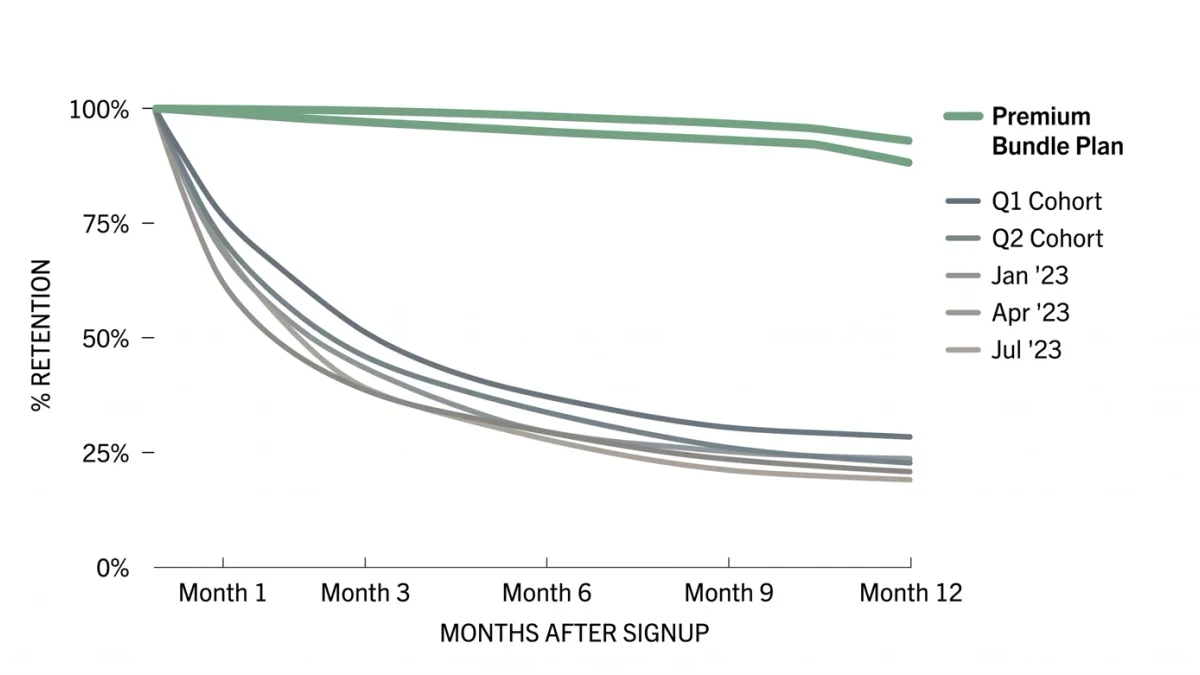
Because a subscription business compounds. Replacing churned subscribers consumes acquisition spending that could otherwise grow the base — the Times reported 11.43 million total subscribers in late 2025 against roughly 10.9 million a year earlier, meaning gross additions ran far ahead of net growth, with churn eating the difference. That invisible gross-add number is why two publishers with identical net growth can have opposite economics: the one adding and losing a third of its base annually is renting readers; the one adding and retaining is building an asset. Publishers that disclose bundle data — the Times chief among them — consistently report that multi-product subscribers (news plus games, cooking, audio, sport) churn materially less than single-product subscribers, which is why the industry's strategic center of gravity moved from the news paywall to the bundle.
What does conversion depend on?
On the ratio of habitual readers to casual ones. The canonical segmentation, formalized in the Times' own accounts of its metered-model years and echoed across INMA case studies, sorts monthly visitors into passers-by, occasional readers and regulars; conversion concentrates overwhelmingly among regulars, so the operative lever is not total traffic but the size of the habitual cohort. Meter limits, registration walls and dynamic paywalls — price and article-count varied by propensity models — are all machines for monetizing that cohort at different intensities. The trade-off is explicit: every tightening of the meter lifts conversion and cuts referral traffic, which matters where advertising still carries real revenue, and the right setting is an empirical question each publisher re-answers quarterly.
How do publishers measure ARPU honestly?
With difficulty, and disclosure discipline varies. The clean figure is subscription ARPU — subscription revenue over average subscribers — but promotional pricing distorts it in the first year, since intro offers commonly discount 70–90 percent off list for periods up to a year. The metric that matters is ARPU at renewal cohorts: what year-two and year-three subscribers pay after stepping up to full price. Publishers that report only blended ARPU while their growth comes from discounted cohorts are borrowing from the future, and the honest comparators — the Times discloses subscriber counts and digital revenue quarterly; most privately held outlets disclose nothing — are few. The practical reader of any subscription announcement should ask for cohort retention curves, which almost no one outside the public companies publishes.
What role does advertising still play?
A complementary and increasingly conditional one. Post-cookie, subscription-first outlets sell advertising against logged-in, known audiences, which command premiums over anonymous inventory — the logic behind registration walls beyond paywall optimization. But advertising at a subscriber-driven outlet is a margin business layered on a subscription base, not a growth engine; when the Times reports digital advertising growing alongside subscriptions, the driver is higher yield per impression on a roughly flat audience, not audience expansion. For smaller publishers without the Times' product surface, the realistic configuration is subscriptions as the core, events and licensing as second revenue, and programmatic display as declining ballast.
What are the failure modes?
Three recur in the industry post-mortems. Churn denial: celebrating net additions while gross churn compounds quietly. Bundle inflation: counting discounted multi-product trials as bundle proof before renewal data exists. And traffic vanity: managing to unique visitors when conversion lives only in the habitual cohort. Each failure mode is a metrics choice before it is a strategy error — which is the standing lesson of the paywall decade. The publishers that made it through did not have better journalism or better technology; they had reporting that made churn, cohort ARPU and habitual-reader share impossible to look away from.